Author: oowoah

  • The Problem with Traditional Webinars: Why Audiences Want More Than a Broadcast

    The Problem with Traditional Webinars: Why Audiences Want More Than a Broadcast

    Traditional Webinars Often Feel One-Way

    Most webinars are one-way conversations. A presenter speaks, slides move forward and the audience watches from a distance. There may be a chat box, a poll or a short question session at the end, but the overall experience is still largely passive. For organisations that want to educate, influence or engage their audience, this creates a clear problem. People do not simply want to watch another presentation. They want to participate, ask questions, network and feel involved.

    The problem with traditional webinars is not that they are useless. They can be efficient, accessible and easy to organise. The issue is that they often fail to create the level of engagement that modern audiences expect. In a crowded digital environment, passive formats struggle to hold attention for long.

    Learning and Leading

    Why Passive Viewing Is No Longer Enough

    Audiences have become more selective about where they invest their time. If a webinar feels like a long advertisement or a static lecture, people disengage quickly. They may log in, but that does not mean they are truly present. Multitasking is common. Attention drifts. Valuable content is missed because the format does not encourage active participation.

    This matters because the goals of a webinar usually go beyond attendance. Businesses want to build trust, generate leads, educate customers or strengthen their brand. Those outcomes depend on engagement, not just registration numbers. A passive audience is less likely to remember the message or take meaningful action afterwards.

    Professional Woman Delivering Key Insights to Business Audience

    People Want Interaction and Presence

    Modern audiences want more than information. They want interaction. They want to ask questions in the moment, feel part of the event and connect with other attendees where appropriate. In many cases, the most valuable part of an event is not only the presentation itself, but the sense of participation around it.

    This is especially true for training sessions, thought leadership events, product demonstrations and industry seminars. People attend not only to consume content, but also to engage with ideas and feel part of a wider conversation. Traditional webinar formats often struggle to deliver that experience.

    Immersive Seminar Experiences Raise the Standard

    Immersive seminar technology offers a more engaging alternative. Instead of treating remote attendees as passive viewers, it creates an environment where they can feel more present and more connected to the event. This can improve attention, increase participation and make the experience more memorable overall.

    For organisers, this opens up new possibilities. Events can reach a wider audience without becoming less personal. Speakers can deliver content in a format that feels more dynamic. Audiences can gain more value because the experience feels closer to being there rather than simply watching from afar. You can see this approach on our Live VR Seminars page.

    The Future of Webinars Must Be More Engaging

    If your organisation is still relying on traditional webinars, it is worth asking whether the format matches the expectations of your audience. Registration numbers alone do not tell the full story. The real question is whether people feel involved, remember the message and leave wanting more.

    At OowOah, we help businesses, educators and event organisers create immersive live seminar experiences that go beyond the limitations of standard webinars. If your audience wants more than a broadcast, the format should evolve to meet that expectation.

    When audiences feel involved rather than passive, online events become more valuable for everyone.

  • Global Talent, Local Meetings: How Borderless Hiring Changes Collaboration

    Global Talent, Local Meetings: How Borderless Hiring Changes Collaboration

    Hiring Without Borders Creates New Opportunities

    Would your business benefit from hiring the best person, regardless of where they live? For many organisations, the answer is clearly yes. Modern businesses are becoming more borderless, and access to global talent is one of the biggest advantages of that shift. Companies are no longer limited to candidates within commuting distance of a physical office. They can recruit specialists, leaders and creative thinkers from a much wider pool.

    However, hiring globally introduces a new challenge. It is one thing to recruit talented people in different locations. It is another to make collaboration feel as productive and connected as being in the office. Global talent can strengthen a business significantly, but only if the organisation has the right environment for people to work together effectively.

    Colleagues Engaged in Office Tasks

    Why Borderless Hiring Is Growing

    Businesses are embracing global hiring for several reasons. It expands access to specialist skills, improves diversity of thought and can help organisations scale more flexibly. In competitive sectors, the ability to hire the best person rather than the nearest person can make a real difference. It also supports resilience. Teams spread across locations may be better positioned to serve international clients, cover multiple time zones and adapt to changing market conditions.

    Yet while recruitment has become more global, collaboration tools have not always kept pace with what teams actually need. Many organisations still rely on a combination of email, chat and standard video calls, even when their workforce is increasingly distributed.

    Selective focus shot of business people co-working together in a modern office space

    The Collaboration Gap in Global Teams

    When people work across countries and time zones, communication needs to be especially clear and effective. Small misunderstandings can become larger delays. Team members may feel isolated if they rarely experience meaningful interaction beyond scheduled calls. Cultural differences, language nuances and varying working patterns can all add complexity.

    This is where the collaboration gap appears. Businesses may succeed in hiring globally, but struggle to create a working environment that feels cohesive. Without a stronger sense of presence and connection, even highly talented teams can find it harder to build trust, share ideas and maintain momentum.

    Why Local-Feeling Meetings Matter

    Global talent works best when meetings still feel local in quality. In other words, people should feel as though they are genuinely meeting together, not merely dialling into a system. This matters for decision-making, brainstorming, onboarding and relationship-building. The more natural the interaction, the easier it is for teams to collaborate confidently across distance.

    Immersive meeting environments can help bridge this gap by making remote collaboration feel more present and more human. They support a stronger sense of shared space, which can improve engagement and reduce the emotional distance that often comes with global working arrangements. Learn more about this on our VR Meeting Rooms page.

    The Future of Work Is Borderless but Connection Still Matters

    Borderless hiring is likely to continue because the benefits are too significant to ignore. The organisations that gain the most from global talent will be those that invest not only in recruitment, but also in the quality of collaboration. Talent alone is not enough. People need the right environment to contribute fully.

    At OowOah, we help businesses create immersive meeting experiences that make remote collaboration feel more connected and more productive. If your organisation is building a global team, the next step is ensuring your meetings feel as strong as your hiring strategy.

    Global talent delivers its greatest value when collaboration feels local, natural and fully connected.

  • Collaboration Should Feel Natural: Why Better Digital Communication Matters

    Collaboration Should Feel Natural: Why Better Digital Communication Matters

    Digital Collaboration Works Best When It Feels Human

    The best conversations do not happen in chat boxes. They happen when people can read body language, make eye contact, respond naturally and feel present with one another. That is why collaboration should feel natural, even when teams are working remotely. Businesses have adopted a wide range of digital tools to keep communication moving, but many of those tools still fall short when it comes to the quality of interaction.

    Messages, comments and standard video calls can be useful for coordination, but they often flatten communication. Tone becomes harder to read. Spontaneity is reduced. People wait their turn more cautiously, interrupt less naturally and miss the subtle cues that help conversations flow in real life. The result is communication that may be functional, but not always effective.

    Business Team Sharing a Laugh During Work

    Why Natural Communication Improves Collaboration

    When communication feels natural, people contribute more freely. They are more likely to ask questions, build on one another’s ideas and resolve misunderstandings quickly. Natural interaction also supports trust. Teams work better together when they can sense reactions, notice engagement and feel the rhythm of a real conversation.

    This matters in every kind of organisation. Whether teams are discussing strategy, solving problems, training staff or meeting clients, the quality of communication influences the quality of the outcome. If the conversation feels awkward or disconnected, collaboration suffers. If it feels fluid and human, better ideas tend to emerge.

    Creative Thinking During Business Meeting

    The Limits of Flat Digital Tools

    Traditional digital tools were designed to make remote communication possible, not necessarily natural. They help people connect across distance, but they do not always recreate the social dynamics that make in-person collaboration effective. A text message cannot capture body language. A video grid cannot fully recreate the feeling of sharing a room. Over time, these limitations can affect energy, engagement and decision-making.

    That is why many businesses are now looking beyond basic communication platforms. They want digital collaboration that supports presence, participation and more realistic interaction rather than simply delivering information from one screen to another.

    Immersive Environments Bring Conversations Closer to Real Life

    Immersive collaboration environments can make digital communication feel far more natural. By creating a stronger sense of shared space, they help people interact in ways that are closer to real-life meetings. Participants feel more aware of one another, more engaged in the conversation and more connected to the environment around them.

    This does not just improve the experience. It can improve the results. Better communication supports better teamwork, stronger relationships and more productive meetings. For organisations that rely on remote or hybrid collaboration, that can create a meaningful competitive advantage. You can learn more on our VR Meeting Rooms page.

    The Future of Collaboration Should Feel Better, Not Just Faster

    Speed and convenience matter, but they are not the only goals. Businesses also need communication that feels clear, engaging and human. Collaboration should feel natural because natural communication is what helps people think, connect and work well together.

    At OowOah, we believe the future of collaboration lies in immersive experiences that bring digital communication closer to real life. If your organisation wants more than functional remote tools, it may be time to create meetings that feel genuinely engaging again.

    The closer digital collaboration feels to real life, the better teams can communicate, connect and create together.

  • Small Venue, Big Audience: How Technology Expands the Reach of Events

    Small Venue, Big Audience: How Technology Expands the Reach of Events

    Your Venue Size Should Not Define Your Event Potential

    Why should your audience be limited by the size of your venue? For many organisers, this is one of the biggest frustrations in events. A seminar, workshop or conference may have strong demand, but physical capacity creates a hard limit. Once seats are filled, interested attendees are turned away or placed on a waiting list. That means missed opportunities for revenue, reach and impact.

    The challenge is especially relevant for businesses, educators, speakers and event organisers who want to grow their audience without immediately taking on the cost and complexity of larger venues. The good news is that technology is changing what is possible. Events no longer need to be constrained by the walls of a room.

    Senior Man and Adult Woman Speaking at Business Panel Event

    The Traditional Limits of In-Person Events

    Physical events offer energy, atmosphere and direct engagement, but they also come with practical limits. Venue hire, staffing, catering, travel and logistics all increase as events grow. Even when organisers are willing to scale up, many attendees still cannot make it due to distance, scheduling or cost. This means the total potential audience is often much larger than the number of people who can physically attend.

    For some organisations, this creates a difficult choice. Keep the event small and exclusive, or expand and take on greater expense and operational risk. Neither option is ideal if the goal is to maximise reach while maintaining quality.

    Business conference participants listening to a young woman's speech

    Technology Makes Audience Expansion Possible

    Modern event technology allows organisers to think differently. Instead of treating remote attendance as a second-rate add-on, immersive solutions can make it a meaningful part of the event experience. People who cannot be in the room physically can still feel engaged, involved and connected to what is happening.

    This creates a powerful opportunity. A small venue can host a local audience while also reaching attendees in other cities, countries or time zones. Organisers can preserve the atmosphere of a live event while extending access far beyond the room itself. That means more ticket sales, broader visibility and a stronger return on the effort invested in planning the event. See how this works on our Live VR Seminars page.

    Why Reach Matters More Than Ever

    In a competitive market, reach matters. Speakers want to grow their profile. Educators want to share knowledge more widely. Businesses want to attract prospects, partners and communities beyond their immediate location. Events are no longer judged only by what happens on site. They are also judged by how effectively they connect with people who could not attend in person.

    By expanding the audience without abandoning the live experience, organisations can create events that feel both premium and accessible. This is particularly valuable for specialist seminars, niche conferences and high-value workshops where demand may come from a geographically dispersed audience.

    From Capacity Limits to Growth Opportunities

    The future of events is not about replacing physical venues. It is about extending their value. A small venue can still deliver a high-quality live experience while technology opens the door to a much bigger audience. That shift turns capacity limits into growth opportunities.

    At OowOah, we help organisers create immersive live seminar experiences that bring events to audiences around the world. If you want your next event to reach beyond the room, immersive technology can help you do it without losing the impact of being live.

    A small venue does not have to mean a small opportunity when immersive technology expands your audience.

  • The Cost of Business Travel: Is There a Better Way to Bring People Together?

    The Cost of Business Travel: Is There a Better Way to Bring People Together?

    Business Travel Has a Bigger Cost Than Many Organisations Realise

    How much time and money is your business spending just getting people into the same room? The cost of business travel is often treated as a normal part of growth, collaboration and client service. Flights, hotels, trains, taxis, meals and venue costs are all easy to identify on a budget sheet. However, the true cost goes further. Travel also consumes time, drains energy and reduces productivity before the meeting has even begun.

    For many organisations, especially those with distributed teams, national clients or international partners, travel remains a routine part of doing business. Yet as costs continue to rise, leaders are asking an important question: is there a better way to collaborate without sacrificing the feeling of being together?

    The Way to the Plane

    The Visible and Hidden Costs of Travel

    The visible costs of business travel are straightforward. Airfares, accommodation and transport can quickly add up, particularly when several people are attending the same event or meeting. Even domestic travel can become expensive once multiple journeys are involved. For organisations managing tight budgets, these costs can limit how often teams meet in person.

    The hidden costs are just as significant. Travel time often means lost working hours. Employees may spend an entire day travelling for a meeting that lasts only a few hours. Fatigue also affects performance. A team member who has rushed through airports, delayed trains or late hotel check-ins is unlikely to arrive feeling fresh, focused and ready to contribute at their best.

    Full length shot of a young African business man walking past glass doors and a potted plant with his luggage, entering a modern hotel in a suit

    Why Businesses Still Value Shared Presence

    Despite the expense, businesses continue to invest in travel because shared presence matters. Important conversations often benefit from eye contact, body language and the energy of being in the same environment. Teams collaborate differently when they feel physically together. That is why many organisations have not been fully satisfied by standard video calls as a replacement.

    The challenge is not simply reducing travel. It is finding a way to preserve the value of shared presence without carrying the full financial and operational burden of constant movement.

    Immersive Alternatives Are Changing Expectations

    Immersive collaboration technology is helping businesses rethink what is possible. Instead of choosing between expensive travel and flat online meetings, organisations can explore environments that create a stronger sense of presence and interaction. This can make remote collaboration feel more natural, more focused and more effective than traditional digital tools.

    For strategy sessions, training, seminars and client engagement, immersive experiences can reduce the need for travel while still supporting meaningful communication. That does not mean travel disappears entirely. It means businesses can reserve it for the moments that truly require it, rather than using it as the default solution. A good place to start is our VR Meeting Rooms page.

    A Smarter Approach to Bringing People Together

    The future of collaboration is not about eliminating human connection. It is about making that connection more efficient, more scalable and more sustainable. Businesses that review the cost of business travel carefully may discover that a significant portion of their travel budget could be reduced without weakening collaboration.

    At OowOah, we help organisations create immersive meeting and seminar experiences that bring people together without requiring everyone to board a plane. If your business wants to reduce travel costs while maintaining stronger engagement, immersive collaboration may be the next step.

    When businesses reduce unnecessary travel, they save more than money. They also recover time, energy and focus.

  • OowOah has been shortlisted for the 2026 Cloud Excellence Awards

    OowOah has been shortlisted for the 2026 Cloud Excellence Awards

    We’re incredibly proud to announce that OowOah has been shortlisted for the 2026 Cloud Excellence Awards in the Most Innovative Cloud Product or Service category. Being recognised alongside some of the UK’s leading cloud innovators is a fantastic achievement and a real milestone for our team.

    While we’re delighted to receive this recognition, this journey hasn’t been ours alone.

    A huge thank you to Xavier from Alibaba Cloud, whose support, guidance and belief in what we were building has been invaluable. We would also like to thank all of the incredible Alibaba Cloud engineers who helped us design, optimise and scale OowOah on the Alibaba Cloud platform. Your expertise has played a massive part in making OowOah what it is today.

    Finally, thank you to everyone who has tested the platform, provided feedback, and believed in our vision of transforming VR meetings and immersive live events. This recognition belongs to all of you as much as it does to us.

    We’re only just getting started, and we can’t wait to show everyone what’s coming next with OowOah VR Meeting Rooms, Quantum Leap, and OowOah Live VR.

    #CloudExcellenceAwards #CloudInnovation #OowOah #AlibabaCloud #VR #Metaverse #ImmersiveTechnology #Innovation #CloudComputing #VirtualReality #TechAwards #FutureOfWork #LiveEvents

  • Training That People Forget: Why Immersive Learning Improves Knowledge Retention

    Training That People Forget: Why Immersive Learning Improves Knowledge Retention

    Why So Much Workplace Training Fails to Stick

    How much of your training do employees remember a week later? For many organisations, this is an uncomfortable question. Time and money are invested in onboarding, compliance, product knowledge and professional development, yet much of the information fades quickly. Traditional training often relies on slides, long presentations and passive observation. People may complete the session, but completion is not the same as retention.

    Training that people forget is a serious business problem. If employees cannot recall what they have learned, the organisation does not receive the full value of its investment. Mistakes are repeated, confidence remains low and further retraining becomes necessary. In fast-moving sectors, poor retention can also affect customer experience, safety and performance.

    Team lunch meeting in the boardroom

    Watching Is Not the Same as Experiencing

    One reason traditional training is often forgotten is that it asks people to absorb information without truly engaging with it. Watching slides or listening to a presenter can communicate facts, but it does not always create a memorable experience. Human beings tend to remember what they do, discuss and feel more strongly than what they passively observe.

    This is especially important when the subject involves decision-making, communication or practical application. Employees need more than information. They need context, interaction and opportunities to apply what they are learning in a way that feels real. Without that, training can become another box-ticking exercise rather than a meaningful development tool.

    Discussions Between Business Colleagues

    Why Immersive Learning Works Better

    Immersive learning improves knowledge retention because it creates stronger mental engagement. When people feel present in a learning environment, they are more likely to focus, participate and remember key points afterwards. Instead of simply hearing about a scenario, they experience it more directly. That creates a deeper connection between the content and the learner.

    In practical terms, immersive training can help employees understand processes, practise communication and build confidence in a more realistic setting. It can also make learning more enjoyable, which matters more than many businesses realise. When training feels engaging rather than obligatory, people are more likely to approach it with energy and curiosity. You can explore broader use cases for immersive business experiences on our Solutions page.

    Retention Supports Better Business Outcomes

    Better retention leads to better execution. Employees who remember their training are more likely to apply it correctly, make sound decisions and work independently. Managers spend less time repeating instructions. Teams become more consistent. Customers and clients receive a better experience because staff are more prepared and more confident in their roles.

    For organisations with distributed teams, immersive learning can also create a more consistent standard across locations. Everyone can access the same high-quality experience without needing to travel to a central training venue. That makes scaling development programmes more practical and more cost-effective.

    Rethinking the Future of Training

    If your organisation is still relying heavily on static presentations, it may be time to rethink what effective learning looks like. Training should not be judged only by attendance or completion rates. It should be judged by what people remember and how confidently they apply it afterwards.

    At OowOah, we believe immersive environments can transform the way businesses train, teach and develop their people. When learning feels real, retention improves and the value of training increases across the organisation.

    The more immersive the learning experience, the more likely employees are to remember what matters.

  • The Remote Team Disconnect: Why Working Remotely Does Not Always Build Real Teams

    The Remote Team Disconnect: Why Working Remotely Does Not Always Build Real Teams

    Remote Work Does Not Automatically Create Connection

    Your team works remotely, but do they actually feel like a team? Many organisations have proved that remote work can keep projects moving, maintain flexibility and widen access to talent. Yet there is a difference between staying operational and feeling connected. Emails, chat platforms and video calls are excellent for updates, deadlines and task management, but they rarely create the kind of relationships that help teams trust one another and work at their best.

    The remote team disconnect is often subtle at first. Work still gets done, meetings still happen and messages still get answered. However, something important can be missing beneath the surface. Team members may know what their colleagues are doing, but not really know them. They may collaborate on tasks without building the sense of familiarity that supports creativity, confidence and honest communication.

    Adult Business Team Working in Office on Project Planning

    Why Relationships Matter in Remote Teams

    Strong teams are not built only through project plans and performance dashboards. They are built through trust, shared understanding and the small moments of interaction that help people feel comfortable with one another. In a physical workplace, these moments happen naturally. A quick chat before a meeting, a conversation after lunch or an informal exchange while solving a problem can all strengthen relationships over time.

    Remote teams often miss these spontaneous interactions. Communication becomes more deliberate and more transactional. People join calls when needed, contribute to the agenda, then leave to move on to the next task. That may seem efficient, but it can reduce the sense of belonging that helps teams perform well under pressure.

    Business Team Sharing a Laugh During Work

    The Impact of Disconnection on Performance

    When remote employees do not feel genuinely connected, several problems can emerge. New ideas are shared less freely. Feedback becomes more cautious. Misunderstandings take longer to resolve. Team members may hesitate to ask for help because they do not feel close enough to others to do so comfortably. Over time, this can affect morale, innovation and retention.

    Disconnection can also create uneven experiences across the organisation. Some people may feel included because they speak often or work closely with managers, while quieter team members become increasingly invisible. This is not just a culture issue. It can influence decision-making, collaboration quality and business outcomes.

    Creating More Human Digital Collaboration

    To overcome the remote team disconnect, businesses need more than another messaging channel. They need collaboration experiences that feel more human. That means creating environments where people can interact more naturally, read social cues more easily and feel present with one another rather than simply connected by software.

    Immersive virtual environments offer a stronger sense of shared presence than standard remote tools. Instead of reducing communication to text threads and flat video windows, they help teams feel as though they are meeting in the same space. This can support more natural conversation, stronger engagement and better relationship-building over time. Learn more about this approach on our Solutions page.

    Remote Teams Need More Than Efficiency

    Efficiency matters, but it is not enough on its own. The best remote teams combine productivity with connection. They create space for trust, creativity and informal interaction, even when people are spread across different cities or countries. Businesses that recognise this are more likely to build resilient teams that work well together for the long term.

    At OowOah, we help organisations create immersive meeting experiences that bring remote teams closer together. If your business wants remote collaboration to feel more like real teamwork, it may be time to move beyond the limitations of standard calls and messages.

    Remote work succeeds when people feel connected not only to the task, but also to each other.

  • The Zoom Fatigue Problem: Why Teams Stop Paying Attention in Video Meetings

    The Zoom Fatigue Problem: Why Teams Stop Paying Attention in Video Meetings

    The Zoom Fatigue Problem Is Not Just About Screen Time

    Is your team really paying attention in video meetings, or are they simply appearing present while their attention drifts elsewhere? The Zoom fatigue problem has become one of the most common challenges facing modern organisations. After hours of back-to-back calls, even capable and committed employees begin to switch off. Cameras stay on, but concentration drops. People check emails, reply to messages, or scroll on their phones while the meeting continues in the background.

    This is not necessarily a sign of poor attitude. In many cases, it is a predictable response to a format that asks people to sit still, stare at a screen, and process a stream of faces and information for long periods of time. Traditional video meetings often demand attention without doing enough to earn it. That is why the real issue is not simply the number of meetings in the diary. The deeper problem is that many meetings no longer feel engaging, purposeful or worth joining.

    Adult Business Team Working in Office on Project Planning

    Why Video Calls Drain Attention

    Video calls can be useful, but they also create a strange communication environment. People are expected to interpret facial expressions through small windows, manage delays, avoid interrupting others, and remain visibly attentive for long stretches. In a physical room, attention moves naturally. In a video call, it often feels forced. Over time, that creates mental fatigue.

    There is also very little variety in the experience. One call can feel almost identical to the next, regardless of the topic. Strategy sessions, client updates, training meetings and internal catch-ups are all squeezed into the same flat format. When every interaction looks and feels the same, people begin to treat meetings as background noise rather than meaningful moments of collaboration.

    Business persons on meeting in the office.

    The Hidden Cost of Disengaged Meetings

    When people stop paying attention, the cost is not limited to a less lively conversation. Important details are missed. Decisions need to be repeated. Follow-up emails become longer. Misunderstandings increase. Meetings that were supposed to save time end up creating more work afterwards. For leaders, this can be especially frustrating because attendance may look high while actual engagement remains low.

    Disengaged meetings also affect culture. If team members begin to associate meetings with passive listening and low value, they are less likely to contribute ideas, ask useful questions or bring energy into shared discussions. Over time, that weakens collaboration across the organisation.

    Better Meetings Need Better Experiences

    The solution is not to eliminate communication. Businesses still need regular contact, alignment and discussion. The goal is to make meetings feel more active, more human and more worthwhile. That means designing experiences that encourage presence rather than passive attendance.

    Immersive collaboration environments can help by making digital meetings feel more like real shared spaces. Instead of looking at a grid of faces, participants feel more connected to the room, the discussion and each other. Body language, spatial awareness and a stronger sense of presence all contribute to better focus. When people feel as though they are genuinely part of the meeting, they are more likely to stay engaged. To see how this works in practice, explore VR Meeting Rooms.

    What Businesses Should Do Next

    If your organisation is experiencing the Zoom fatigue problem, it is worth reviewing not only how often meetings happen, but how they happen. Ask whether each meeting has a clear purpose, whether the format supports real interaction, and whether participants leave with clarity and momentum. Better meetings are not created by adding more agenda points. They are created by improving the quality of the experience itself.

    At OowOah, we believe digital collaboration should feel more engaging, more natural and more immersive than a standard video call. If your team is tired of flat online meetings, now is the time to explore a better way to connect.

    When meetings feel worth joining, people stop pretending to pay attention and start contributing properly.

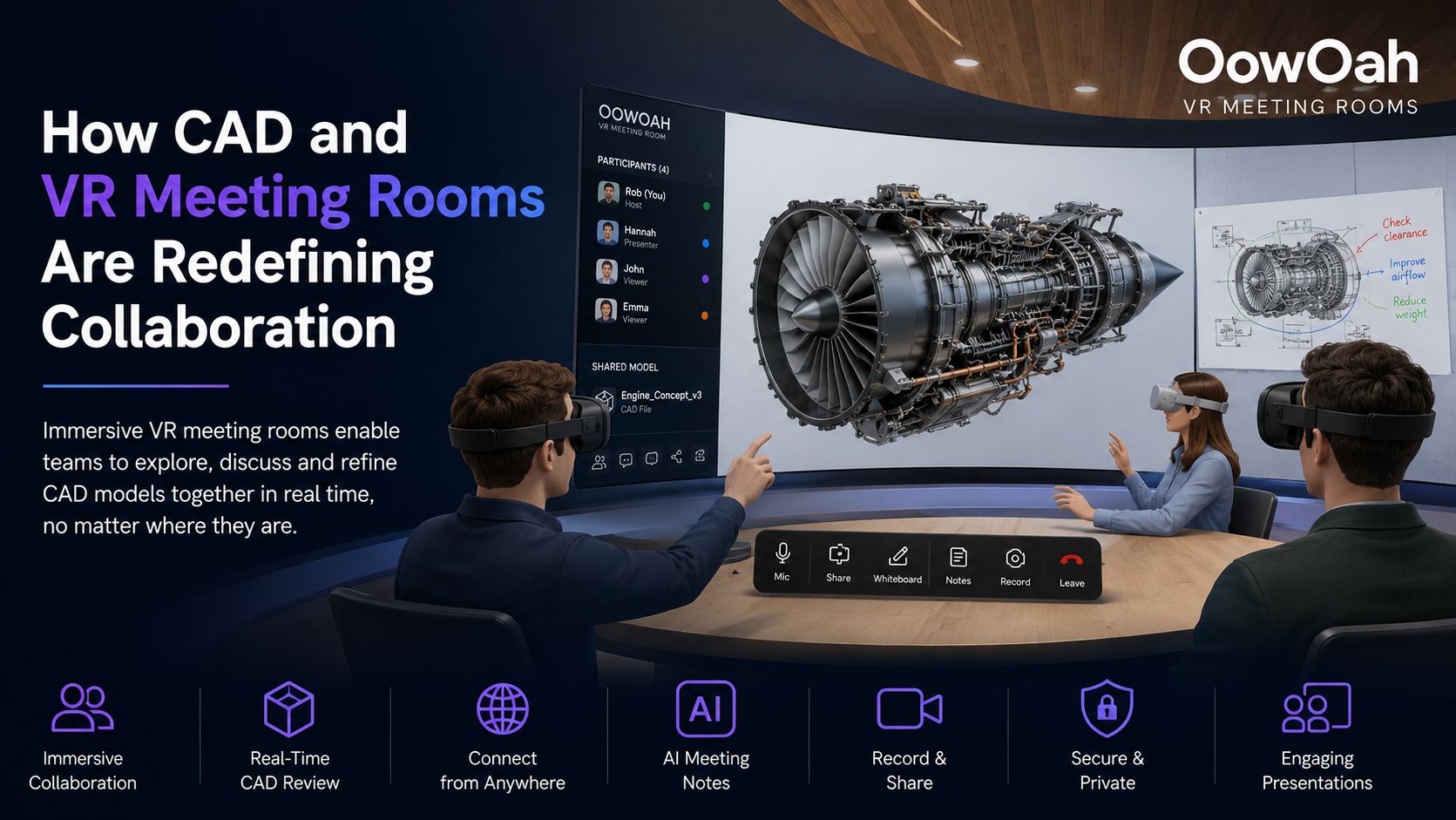
  • How CAD and VR Meeting Rooms Are Redefining Collaboration

    How CAD and VR Meeting Rooms Are Redefining Collaboration

    The way businesses collaborate is changing rapidly. While video conferencing has become the standard for remote meetings, it often falls short when teams need to review complex CAD models, engineering drawings or product designs.

    That’s where Virtual Reality (VR) meeting rooms are making a real difference.

    Instead of looking at a 3D model on a flat screen, teams can step into a shared virtual workspace and experience designs together in a far more natural and interactive way. Whether you’re designing a new product, reviewing a building project or presenting a concept to a client, VR allows everyone to see the same model from the same perspective—making collaboration faster, clearer and more engaging.

    Bringing Designs to Life

    CAD software has transformed the way products and buildings are designed, but reviewing those designs remotely can still be challenging.

    With VR meeting rooms, engineers, architects, designers and clients can explore full-scale models together, discuss changes in real time and gain a much better understanding of how a project will look and function before it’s built.

    This helps reduce misunderstandings, speeds up approvals and can minimise costly design changes later in the project.

    Collaborate from Anywhere

    One of the biggest advantages of VR collaboration is that location no longer matters.

    Teams working across different offices—or even different countries—can meet in the same virtual room without the need for travel. Everyone has the same view of the project, making discussions more productive and helping decisions happen much faster.

    It’s an ideal solution for hybrid and remote teams that regularly work with complex visual information.

    More Than Just a Meeting

    Modern VR meeting rooms offer far more than voice and video. They provide immersive environments where teams can share presentations, review documents, discuss CAD models and collaborate naturally.

    Features such as spatial audio, AI-generated meeting notes, meeting recording and private note-taking help create a more productive experience while reducing the need for lengthy follow-up emails.

    The Future of Business Collaboration

    As businesses continue to embrace digital transformation, immersive collaboration is becoming an increasingly valuable tool across industries including engineering, manufacturing, construction, architecture and product design.

    Rather than replacing existing CAD software, VR enhances it by allowing teams to experience and discuss designs together in ways that simply aren’t possible with traditional video conferencing.

    At OowOah VR Meeting Rooms, we’re helping businesses take collaboration to the next level with immersive meeting spaces designed for modern teams.

    If your organisation works with CAD models, technical drawings or complex projects, VR collaboration could transform the way your teams communicate, review designs and make decisions.

    The future of collaboration isn’t just online—it’s immersive.