We’re incredibly proud to announce that OowOah has been shortlisted for the 2026 Cloud Excellence Awards in the Most Innovative Cloud Product or Service category. Being recognised alongside some of the UK’s leading cloud innovators is a fantastic achievement and a real milestone for our team.
While we’re delighted to receive this recognition, this journey hasn’t been ours alone.
A huge thank you to Xavier from Alibaba Cloud, whose support, guidance and belief in what we were building has been invaluable. We would also like to thank all of the incredible Alibaba Cloud engineers who helped us design, optimise and scale OowOah on the Alibaba Cloud platform. Your expertise has played a massive part in making OowOah what it is today.
Finally, thank you to everyone who has tested the platform, provided feedback, and believed in our vision of transforming VR meetings and immersive live events. This recognition belongs to all of you as much as it does to us.
We’re only just getting started, and we can’t wait to show everyone what’s coming next with OowOah VR Meeting Rooms, Quantum Leap, and OowOah Live VR.
How much of your training do employees remember a week later? For many organisations, this is an uncomfortable question. Time and money are invested in onboarding, compliance, product knowledge and professional development, yet much of the information fades quickly. Traditional training often relies on slides, long presentations and passive observation. People may complete the session, but completion is not the same as retention.
Training that people forget is a serious business problem. If employees cannot recall what they have learned, the organisation does not receive the full value of its investment. Mistakes are repeated, confidence remains low and further retraining becomes necessary. In fast-moving sectors, poor retention can also affect customer experience, safety and performance.
Watching Is Not the Same as Experiencing
One reason traditional training is often forgotten is that it asks people to absorb information without truly engaging with it. Watching slides or listening to a presenter can communicate facts, but it does not always create a memorable experience. Human beings tend to remember what they do, discuss and feel more strongly than what they passively observe.
This is especially important when the subject involves decision-making, communication or practical application. Employees need more than information. They need context, interaction and opportunities to apply what they are learning in a way that feels real. Without that, training can become another box-ticking exercise rather than a meaningful development tool.
Why Immersive Learning Works Better
Immersive learning improves knowledge retention because it creates stronger mental engagement. When people feel present in a learning environment, they are more likely to focus, participate and remember key points afterwards. Instead of simply hearing about a scenario, they experience it more directly. That creates a deeper connection between the content and the learner.
In practical terms, immersive training can help employees understand processes, practise communication and build confidence in a more realistic setting. It can also make learning more enjoyable, which matters more than many businesses realise. When training feels engaging rather than obligatory, people are more likely to approach it with energy and curiosity. You can explore broader use cases for immersive business experiences on our Solutions page.
Retention Supports Better Business Outcomes
Better retention leads to better execution. Employees who remember their training are more likely to apply it correctly, make sound decisions and work independently. Managers spend less time repeating instructions. Teams become more consistent. Customers and clients receive a better experience because staff are more prepared and more confident in their roles.
For organisations with distributed teams, immersive learning can also create a more consistent standard across locations. Everyone can access the same high-quality experience without needing to travel to a central training venue. That makes scaling development programmes more practical and more cost-effective.
Rethinking the Future of Training
If your organisation is still relying heavily on static presentations, it may be time to rethink what effective learning looks like. Training should not be judged only by attendance or completion rates. It should be judged by what people remember and how confidently they apply it afterwards.
At OowOah, we believe immersive environments can transform the way businesses train, teach and develop their people. When learning feels real, retention improves and the value of training increases across the organisation.
The more immersive the learning experience, the more likely employees are to remember what matters.
A remote team can exchange messages all day and still miss the context behind a decision. Someone joins a project late, a handover loses an important detail or a question stays unanswered because nobody knows whom to ask. Start by finding the point where work breaks down. More meetings alone will not necessarily fix it.
Find one recurring gap
Ask colleagues to describe a recent situation that was difficult to follow. Was the decision made in a conversation they missed? Was a document changed without an explanation? Did they know who could help? Specific examples are more useful than asking whether everyone feels engaged.
Choose one repeated problem to address first. If new starters cannot find the current project information, organise that information and name a contact. A social session may be enjoyable, but it is a different response to a different need.
Put shared information somewhere people can find it
Give a piece of work a clear home: the current document, the decision it supports and the person responsible. Link to that source in the invitation rather than sending competing versions around the team.
Explain what has changed and what colleagues need to do. For example: “The client has approved the layout. Please review the two remaining access options before Thursday.” This is a sample instruction, not a client case study. It gives people a reason to open the material and a clear point to discuss.
Use live time for the unresolved part
A progress report can often be read before a call. Reserve the conversation for competing requirements, an unfamiliar problem or a decision that benefits from people responding together. Invite those who can contribute to that question rather than everyone connected with the project.
Let participants prepare comments in advance, particularly across time zones. During the session, leave pauses for questions and invite different views without requiring everyone to speak on demand. A quiet participant may need thinking time or a different way to contribute.
Where could a shared VR room fit?
OowOah VR Meeting Rooms provide a shared digital setting for a suitable group, with avatars, spatial audio and presentation screens. A planned project discussion or client workshop could be a useful session to try there. The question is whether that setting helps your particular group follow the material and work through the issue.
Each participant needs a compatible Meta Quest 3 or Meta Quest 3S and appropriate access. Give people time to practise joining and using the controls. Check comfort and retain another communication route for anyone who cannot use the headset experience.
Bring the missing view into the conversation
Some handovers need more than a written description. A colleague may need to show the position of equipment or explain a prototype. Quantum Leap is OowOah’s first-person streaming approach for bringing a person’s live view into the VR meeting.
Plan a short sequence: what must be shown, which questions need answering and what information should be recorded afterwards. A remote view can support a discussion, but it does not replace physical checks that the task still requires.
Make the handover visible after the meeting
End with a short account of the decision, the action owner and the next date. Distinguish an agreed decision from an idea that still needs investigation. Someone who could not attend should be able to understand what changed without watching an entire recording.
Where recordings, transcripts or AI notes are used, agree access and review the record for accuracy. The person responsible for an action should confirm that they understand it. A generated summary is a starting point for checking, not a substitute for agreement.
Check whether the routine is helping
After a few comparable sessions, ask whether colleagues spend less time searching for information, repeating explanations or reopening decisions. Include feedback from new starters and people working in other locations. Keep what helps and change what creates extra work.
The Zoom Fatigue Problem Is Not Just About Screen Time
Is your team really paying attention in video meetings, or are they simply appearing present while their attention drifts elsewhere? The Zoom fatigue problem has become one of the most common challenges facing modern organisations. After hours of back-to-back calls, even capable and committed employees begin to switch off. Cameras stay on, but concentration drops. People check emails, reply to messages, or scroll on their phones while the meeting continues in the background.
This is not necessarily a sign of poor attitude. In many cases, it is a predictable response to a format that asks people to sit still, stare at a screen, and process a stream of faces and information for long periods of time. Traditional video meetings often demand attention without doing enough to earn it. That is why the real issue is not simply the number of meetings in the diary. The deeper problem is that many meetings no longer feel engaging, purposeful or worth joining.
Why Video Calls Drain Attention
Video calls can be useful, but they also create a strange communication environment. People are expected to interpret facial expressions through small windows, manage delays, avoid interrupting others, and remain visibly attentive for long stretches. In a physical room, attention moves naturally. In a video call, it often feels forced. Over time, that creates mental fatigue.
There is also very little variety in the experience. One call can feel almost identical to the next, regardless of the topic. Strategy sessions, client updates, training meetings and internal catch-ups are all squeezed into the same flat format. When every interaction looks and feels the same, people begin to treat meetings as background noise rather than meaningful moments of collaboration.
The Hidden Cost of Disengaged Meetings
When people stop paying attention, the cost is not limited to a less lively conversation. Important details are missed. Decisions need to be repeated. Follow-up emails become longer. Misunderstandings increase. Meetings that were supposed to save time end up creating more work afterwards. For leaders, this can be especially frustrating because attendance may look high while actual engagement remains low.
Disengaged meetings also affect culture. If team members begin to associate meetings with passive listening and low value, they are less likely to contribute ideas, ask useful questions or bring energy into shared discussions. Over time, that weakens collaboration across the organisation.
Better Meetings Need Better Experiences
The solution is not to eliminate communication. Businesses still need regular contact, alignment and discussion. The goal is to make meetings feel more active, more human and more worthwhile. That means designing experiences that encourage presence rather than passive attendance.
Immersive collaboration environments can help by making digital meetings feel more like real shared spaces. Instead of looking at a grid of faces, participants feel more connected to the room, the discussion and each other. Body language, spatial awareness and a stronger sense of presence all contribute to better focus. When people feel as though they are genuinely part of the meeting, they are more likely to stay engaged. To see how this works in practice, explore VR Meeting Rooms.
What Businesses Should Do Next
If your organisation is experiencing the Zoom fatigue problem, it is worth reviewing not only how often meetings happen, but how they happen. Ask whether each meeting has a clear purpose, whether the format supports real interaction, and whether participants leave with clarity and momentum. Better meetings are not created by adding more agenda points. They are created by improving the quality of the experience itself.
At OowOah, we believe digital collaboration should feel more engaging, more natural and more immersive than a standard video call. If your team is tired of flat online meetings, now is the time to explore a better way to connect.
When meetings feel worth joining, people stop pretending to pay attention and start contributing properly.
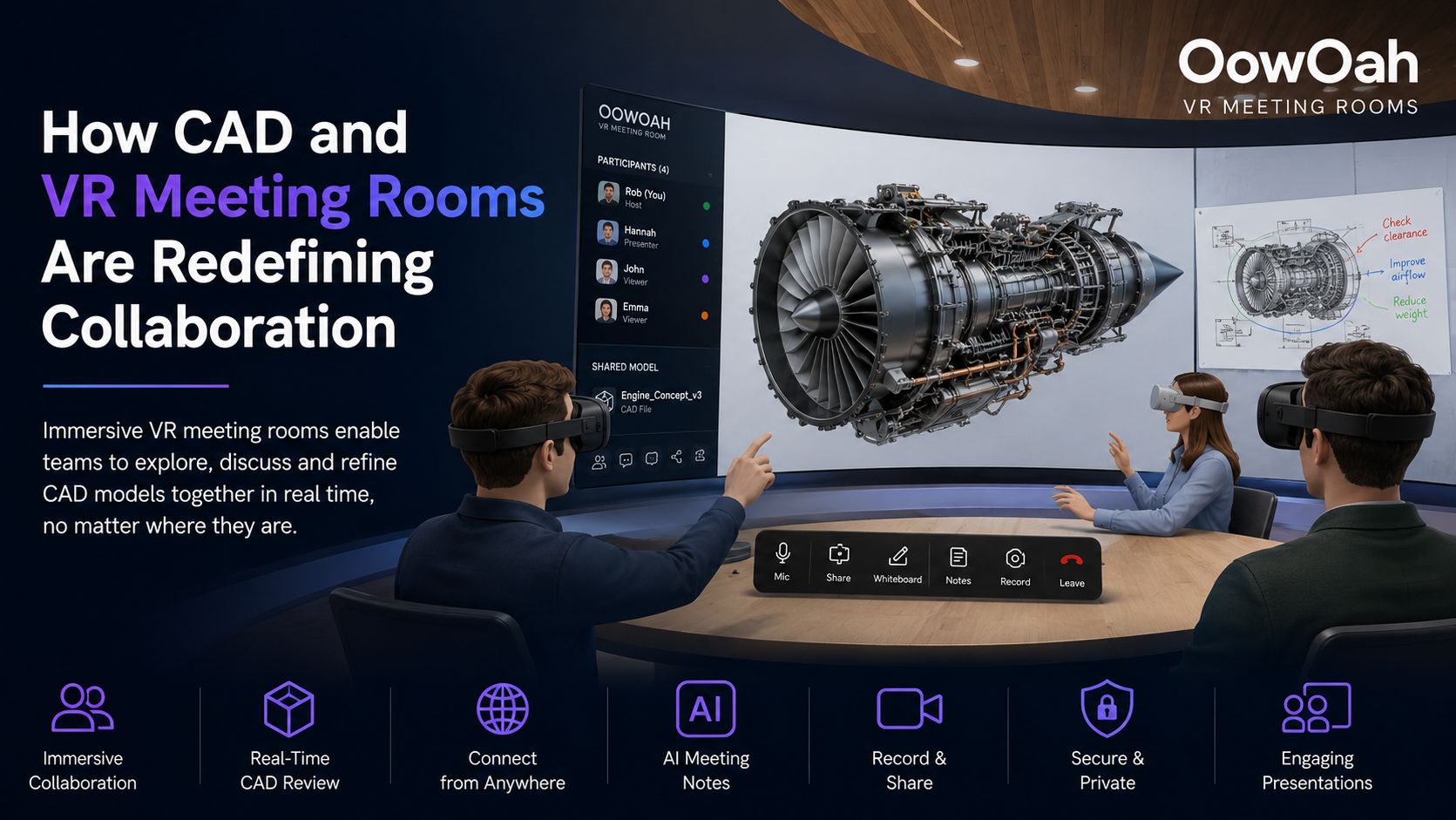
The way businesses collaborate is changing rapidly. While video conferencing has become the standard for remote meetings, it often falls short when teams need to review complex CAD models, engineering drawings or product designs.
That’s where Virtual Reality (VR) meeting rooms are making a real difference.
Instead of looking at a 3D model on a flat screen, teams can step into a shared virtual workspace and experience designs together in a far more natural and interactive way. Whether you’re designing a new product, reviewing a building project or presenting a concept to a client, VR allows everyone to see the same model from the same perspective—making collaboration faster, clearer and more engaging.
Bringing Designs to Life
CAD software has transformed the way products and buildings are designed, but reviewing those designs remotely can still be challenging.
With VR meeting rooms, engineers, architects, designers and clients can explore full-scale models together, discuss changes in real time and gain a much better understanding of how a project will look and function before it’s built.
This helps reduce misunderstandings, speeds up approvals and can minimise costly design changes later in the project.
Collaborate from Anywhere
One of the biggest advantages of VR collaboration is that location no longer matters.
Teams working across different offices—or even different countries—can meet in the same virtual room without the need for travel. Everyone has the same view of the project, making discussions more productive and helping decisions happen much faster.
It’s an ideal solution for hybrid and remote teams that regularly work with complex visual information.
More Than Just a Meeting
Modern VR meeting rooms offer far more than voice and video. They provide immersive environments where teams can share presentations, review documents, discuss CAD models and collaborate naturally.
Features such as spatial audio, AI-generated meeting notes, meeting recording and private note-taking help create a more productive experience while reducing the need for lengthy follow-up emails.
The Future of Business Collaboration
As businesses continue to embrace digital transformation, immersive collaboration is becoming an increasingly valuable tool across industries including engineering, manufacturing, construction, architecture and product design.
Rather than replacing existing CAD software, VR enhances it by allowing teams to experience and discuss designs together in ways that simply aren’t possible with traditional video conferencing.
At OowOah VR Meeting Rooms, we’re helping businesses take collaboration to the next level with immersive meeting spaces designed for modern teams.
If your organisation works with CAD models, technical drawings or complex projects, VR collaboration could transform the way your teams communicate, review designs and make decisions.
The future of collaboration isn’t just online—it’s immersive.
Collaboration Technology is Changing the Way Businesses Work
The modern workplace has changed dramatically over the past few years. Teams are no longer confined to a single office, with employees working remotely, travelling between locations and collaborating with partners around the world.
Traditional video conferencing platforms have helped businesses stay connected, but many organisations are now looking for more engaging and productive ways to work together.
This is where collaboration technology and enterprise collaboration solutions are making a significant impact.
Businesses are adopting immersive collaboration platforms that bring people together in virtual environments, allowing teams to communicate naturally, share ideas more effectively and improve productivity.
What is Collaboration Technology?
Collaboration technology refers to digital tools that enable people to communicate, share information and work together regardless of their physical location.
These technologies include:
Virtual Reality (VR) meeting rooms
Video conferencing
Screen sharing
Real-time collaboration
Shared workspaces
Cloud document management
AI-powered meeting assistants
Instant messaging
Interactive presentations
The goal is simple:
Create better communication while reducing travel costs and improving efficiency.
Why Enterprise Collaboration Solutions Matter
Large organisations often have offices spread across different cities or countries.
Without the right collaboration tools, teams can struggle with:
Poor communication
Long email chains
Inefficient meetings
Lost productivity
Travel expenses
Lack of engagement
Enterprise collaboration solutions solve these challenges by creating a central place where employees can meet, communicate and collaborate in real time.
The result is:
Faster decision making
Better teamwork
Increased employee engagement
Improved knowledge sharing
Lower operational costs
The Rise of Virtual Reality Collaboration
One of the fastest-growing areas of collaboration technology is Virtual Reality.
Instead of appearing in small video windows, participants enter a shared virtual meeting room where they can:
Speak naturally using spatial audio
Present on giant virtual screens
Brainstorm together
View 3D models
Collaborate on projects
Hold training sessions
Meet clients from anywhere in the world
The experience feels far more engaging than a traditional video call.
AI is Making Meetings Smarter
Artificial Intelligence is becoming a core part of enterprise collaboration solutions.
AI can now:
Create automatic meeting notes
Generate summaries
Record action points
Translate conversations
Provide live captions
Search previous meetings
Help organise tasks
This saves valuable time while ensuring nothing gets missed.
Benefits of Enterprise Collaboration Solutions
Businesses investing in modern collaboration technology are seeing measurable benefits.
Increased Productivity
Teams spend less time travelling and more time working.
Better Employee Engagement
Immersive environments encourage participation and interaction.
Reduced Costs
Travel, accommodation and meeting room expenses can be dramatically reduced.
Improved Training
Remote employees can receive interactive training from anywhere.
Faster Innovation
Ideas can be shared instantly between departments and international offices.
Greater Flexibility
Employees can work from almost anywhere without sacrificing collaboration.
The Next Evolution Beyond Traditional Video Calls
Video conferencing transformed remote working, but technology continues to evolve.
Virtual collaboration platforms offer:
Greater presence
Better interaction
Improved engagement
More natural conversations
Richer presentations
Collaborative 3D environments
Many businesses now see immersive collaboration as the natural next step in workplace communication.
Choosing the Right Collaboration Platform
When selecting an enterprise collaboration solution, consider:
Ease of use
Security
Scalability
AI capabilities
Integration with existing systems
Multi-device support
Recording features
Analytics and reporting
The right platform should improve communication without adding unnecessary complexity.
The Future of Enterprise Collaboration
As businesses continue to embrace hybrid working, collaboration technology will become even more important.
Artificial Intelligence, Virtual Reality and immersive communication are shaping the future of work.
Organisations that invest early in enterprise collaboration solutions will be better equipped to attract talent, improve productivity and stay competitive in an increasingly digital world.
The future isn’t just about meeting online—it’s about working together as though everyone is in the same room, wherever they are in the world.
Conclusion
Collaboration technology is redefining how businesses communicate, innovate and grow. Whether your team is spread across different offices or across continents, the latest enterprise collaboration solutions provide the tools needed to work smarter, reduce costs and improve engagement.
The organisations that embrace immersive collaboration today will be the ones leading tomorrow.
Imagine your site manager walking around a construction site while your engineers sit safely back at the office. Yet everyone sees exactly what the site manager sees. Questions are answered in real time, issues are identified earlier and decisions happen faster. That is the practical power behind Quantum Leap.
For industries that depend on site visits, inspections, technical reviews and live coordination, distance can slow everything down. Travel takes time. Safety constraints limit access. Delays in communication can affect cost, quality and progress. Quantum Leap offers a smarter way to bridge that gap.
With immersive live viewing, office-based teams can experience the environment as it is happening. Instead of relying on static photos, delayed reports or fragmented updates, they gain a more immediate and accurate understanding of conditions on the ground.
Engineers can review details without travelling
Managers can support decisions in real time
Specialists can join remotely when needed
Organisations can reduce unnecessary site visits
This improves responsiveness while also supporting safer and more efficient ways of working.
Why it matters for construction and technical operations
Construction, infrastructure and engineering projects often involve multiple stakeholders who need visibility into the same environment. When information is delayed or incomplete, problems can escalate. A more immersive way to share live context helps teams align faster and make better-informed decisions.
Quantum Leap is especially valuable where expert input is needed quickly, where travel is impractical, or where safety and efficiency must be balanced carefully. It allows organisations to bring the right people into the situation without requiring everyone to be physically present.
From observation to action
The value of immersive remote access is not only what people can see. It is what they can do with that visibility. Teams can discuss issues immediately, confirm next steps faster and improve coordination between field and office roles. That means fewer delays, clearer communication and stronger operational control.
At OowOah, we see this as more than a technical feature. It is a meaningful step forward in how organisations collaborate across physical and digital environments.
That is Quantum Leap
Quantum Leap represents a more connected way of working, where expertise is not limited by location and important decisions do not have to wait for travel, scheduling or second-hand updates. It brings teams closer to the reality of the moment, wherever they are.
Your site manager is on site. Your engineers are in the office. Everyone sees the same reality.
Many organisations accept poor meeting habits as normal. Cameras are off, attention drifts, people talk over one another and the session ends with limited clarity. It is easy to assume this is simply the reality of remote collaboration. In truth, much of the problem comes from the environment itself.
When the meeting experience feels flat and disconnected, behaviour follows. Engagement drops. Communication becomes less natural. Collaboration suffers. But when the environment is more immersive and shared, the quality of interaction can improve dramatically.
Before OowOah
Cameras off
People distracted
Talking over each other
These are common signs of meetings that are not fully working. Participants feel detached, the pace becomes uneven and valuable ideas can get lost in the noise. Over time, this affects productivity, team morale and the quality of decision-making.
After OowOah
Shared space
Better engagement
Real collaboration
That change is not cosmetic. A shared immersive environment helps people feel more present, more attentive and more willing to participate. Meetings become easier to follow and more productive to join. Instead of competing for attention, participants work within the same experience.
Why the shift is so important
Better meetings create wider business benefits. Teams align faster, projects move more smoothly and communication becomes more consistent across locations. Leaders gain more confidence that important discussions are producing useful outcomes rather than draining time and energy.
For businesses investing in hybrid or remote ways of working, improving the quality of collaboration is no longer optional. It is a strategic advantage. The organisations that create stronger digital experiences will build stronger teams and make better decisions.
A clearer picture of what is possible
The contrast between before and after is simple but powerful. Before, meetings feel passive and fragmented. After, they feel shared, engaging and purposeful. That is the difference OowOah is designed to deliver.
When people feel present, they contribute more. When they contribute more, collaboration improves. And when collaboration improves, organisations move forward with greater clarity and confidence.
Before: disconnected meetings. After: shared space, stronger engagement and real collaboration.
Remote working has given organisations greater flexibility, wider access to talent and new ways to operate across locations. Yet for many teams, something important has been lost along the way. Too often, remote collaboration feels flat, fragmented and isolating. Conversations become more transactional, people disengage, and meetings feel like something to get through rather than something that moves work forward.
At OowOah, we believe remote working should not feel lonely. It should feel connected, natural and productive. When people share the same virtual space, communication becomes easier, collaboration becomes more fluid, and the experience feels far more like being together in person.
Why traditional remote meetings fall short
Standard video calls have become the default for distributed teams, but they often create distance rather than reduce it. Participants stare at small rectangles on a screen, wait for audio delays, miss body language and struggle to build momentum. Even when everyone is present, the meeting can still feel disconnected.
Conversations feel more formal and less spontaneous
Team members are more likely to multitask or switch off
Collaboration becomes harder when energy and presence are missing
Newer or quieter colleagues can find it difficult to contribute
Over time, this affects more than meetings. It can weaken culture, reduce engagement and make remote teams feel less like a team at all.
A shared room changes everything
Inside OowOah, your team shares the same room, talks naturally and collaborates together. That simple shift has a powerful effect. Instead of feeling like separate people dialling in from different places, participants feel present in one environment with a shared focus.
The result is surprisingly real. Meetings become more conversational. People pay closer attention. Ideas move faster because the environment supports genuine interaction rather than forcing everyone through a flat interface.
Better presence, better collaboration
Presence matters in business. When people feel present, they listen more carefully, respond more naturally and contribute more confidently. This is especially important for leadership discussions, project planning, training sessions and creative collaboration where nuance and engagement make a measurable difference.
Immersive meeting environments help teams reconnect with the human side of work. They support stronger communication, clearer alignment and a greater sense of shared purpose, even when participants are physically far apart.
Remote does not have to mean distant
The future of work is not about returning to old limitations. It is about improving the way people connect wherever they are. With the right environment, remote teams can feel more engaged, more collaborative and more united.
OowOah helps organisations move beyond basic video calls and create remote experiences that feel immersive, professional and genuinely connected. Because remote teams do not have to feel remote.
Remote working should feel connected, not isolated.
Many business meetings begin with the same familiar phrase: can everyone hear me? It is a small question, but it reflects a much bigger issue. Too many digital meetings start with friction, technical uncertainty and a sense that everyone is joining from separate worlds rather than entering one shared space.
When that happens, the tone of the meeting is set immediately. Attention drops, energy feels lower and collaboration becomes harder than it should be. Instead of creating focus, the technology gets in the way.
Now imagine starting differently. Instead of asking whether the audio works, you simply say, welcome to the meeting. That shift matters. It signals confidence, presence and professionalism. It turns the meeting from a technical exercise into a real shared experience.
At OowOah, immersive meeting spaces are designed to make digital collaboration feel more natural. Participants do not just connect to a call. They enter an environment built for engagement, discussion and shared attention.
Why presence changes outcomes
When people feel as though they are really there, they contribute differently. They are more likely to listen actively, respond in the moment and stay focused on the conversation. This improves the quality of discussion and helps meetings produce clearer outcomes.
Introductions feel smoother and more professional
Participants are more engaged throughout the session
Conversations flow more naturally
Teams collaborate with greater confidence and clarity
For organisations that rely on regular meetings across locations, that improvement can have a meaningful impact on communication, decision-making and team culture.
Beyond the video call mindset
Traditional video conferencing has served an important purpose, but it was never the final answer. As expectations rise, businesses need meeting experiences that feel more immersive, more polished and more aligned with the way people naturally communicate.
Meeting like you are there is not just about appearance. It is about reducing friction, improving engagement and helping every participant feel part of the same conversation from the very start.
Welcome to a more natural meeting experience
OowOah helps organisations move beyond the limitations of standard calls and into immersive meeting environments that feel more human and more effective. The goal is simple: stop wasting the first minutes of every meeting on technical uncertainty and start with presence, purpose and connection.
Stop saying, can everyone hear me? Start saying, welcome to the meeting.
Most meetings do not end when the conversation finishes. They continue through a trail of follow-up tasks: writing notes, organising actions, clarifying decisions and chasing people for the details everyone half-remembers. For busy teams, that administrative burden quietly consumes valuable time.
That is why practical AI matters. Not AI for novelty. Not AI that adds another layer of complexity. AI that actually saves time by removing repetitive work and helping teams move straight from discussion to action.
Imagine finishing a meeting and already being organised
Imagine finishing a meeting and your notes are already organised. Key points are captured. Actions are clear. Important decisions are not lost. Instead of spending the next half hour typing everything up, you can focus on what happens next.
No typing up rushed notes after the call
No forgotten actions buried in someone’s notebook
No chasing minutes around the team
No uncertainty about who is doing what next
Just get on with your day, with the confidence that the meeting has produced something useful and usable.
Why this matters for modern teams
In fast-moving organisations, small inefficiencies quickly become expensive. If every meeting creates manual follow-up work, the cost adds up across departments, projects and leadership time. Teams lose momentum when outcomes are unclear or when administrative tasks delay the next step.
AI support should reduce friction, not create it. The best tools work quietly in the background, helping people stay focused during the meeting and better prepared afterwards.
From conversation to action
When meetings are immersive and well supported, people engage more fully in the discussion. When AI then helps organise what happened, the value of the meeting continues beyond the room. Teams can review outcomes faster, assign responsibilities more clearly and move into delivery without unnecessary delay.
This is where OowOah creates a stronger meeting experience. It combines immersive presence with practical efficiency, helping organisations improve both the quality of collaboration and the speed of follow-through.
Technology should give time back
The real promise of AI in business is simple: it should give people time back. Time to think, decide, create and lead. Time to focus on meaningful work instead of repetitive administration.
That is the difference between AI that sounds impressive and AI that actually saves time. For modern organisations, the value is not in the hype. It is in the hours recovered and the clarity gained after every important conversation.
No typing. No forgotten actions. No chasing minutes. Just better follow-through.
Business travel has always been a necessary expense. Whether it’s meeting clients, visiting project sites, attending board meetings or bringing remote teams together, travelling can quickly become one of the largest operational costs for many organisations.
Flights, hotels, fuel, train tickets, meals and lost working hours all add up.
But what if many of those meetings didn’t require anyone to travel at all?
The Hidden Cost of Business Travel
When most businesses think about travel costs, they usually consider transport and accommodation. However, the true cost is much greater.
Every trip also includes:
Hours spent travelling instead of working
Delays and cancellations
Increased stress and fatigue
Reduced productivity
Environmental impact
Time away from family and other commitments
Even a single day of travel for several employees can cost thousands of pounds once salaries and lost productivity are taken into account.
Meet Together Without Leaving the Office
OowOah VR Meeting Rooms allow colleagues, customers and partners to meet inside the same immersive virtual meeting room, regardless of where they are in the world.
Instead of joining another video call, participants enter a shared virtual environment where they can communicate naturally, collaborate on presentations and discuss projects as if they were sitting around the same table.
The result is a far more engaging experience than traditional online meetings.
Better Collaboration, Lower Costs
Replacing just a handful of business trips each month can significantly reduce operating costs.
Businesses can benefit from:
Lower travel expenses
Reduced accommodation costs
Less time away from work
Faster decision making
More frequent collaboration
Improved work-life balance
Reduced carbon footprint
Travel only when it genuinely adds value. Meet virtually for everything else.
Present Like You’re in the Same Room
OowOah isn’t simply another video conferencing platform.
Teams can present on large virtual screens, review documents together and communicate naturally using spatial audio, creating a much more immersive experience than standard video meetings.
Whether you’re delivering sales presentations, project updates or staff training, everyone feels part of the same meeting.
AI Meeting Notes Included
Every meeting can generate AI-powered meeting notes, helping teams capture important discussions and agreed actions automatically.
That means less time writing minutes and more time focusing on the conversation.
Perfect for Modern Businesses
OowOah is ideal for organisations with:
Remote teams
Multiple office locations
International customers
Hybrid working environments
Consultants and trainers
Sales teams
Project managers
Construction and engineering companies
Wherever your people are, OowOah brings them together.
The Future of Business Meetings
Business meetings no longer need to involve expensive travel or hours spent in airports and traffic.
With immersive VR Meeting Rooms, organisations can reduce costs, improve collaboration and create more productive meetings from almost anywhere in the world.
If you’re looking for a smarter way to connect your team, it may be time to leave traditional video calls behind and step into the next generation of business collaboration.
Discover OowOah VR Meeting Rooms
Experience immersive meetings, AI-powered collaboration, giant virtual presentation screens and a new way to work together.
Zoom can still be a sensible choice for a business meeting. The useful question is whether your current format helps people do the work in front of them. A quick update, a design discussion and a live site review need different kinds of attention. You can keep familiar video calls while testing a shared VR room for a particular task.
Start with what is going wrong
If a meeting regularly ends without a decision, first look at its purpose. Were the options clear? Did the right people attend? Was someone responsible for recording the outcome? A different environment cannot answer those questions for you.
Separate process problems from presentation problems. An unclear agenda needs preparation. An unreadable drawing needs better material. A group struggling to discuss several pieces of information together may have a reason to try a different meeting setting. Name the problem before choosing a replacement.
Keep video calls where they work well
An external guest may already know how to join your usual meeting service. For a brief conversation, that familiar access can matter more than a new environment. A telephone call or written update may be enough when the task is simply to confirm a detail.
Do not make headset ownership a condition of every client conversation. Use a format the participants can access comfortably, and keep another route available when VR is unsuitable. Different tools can serve the same business without every meeting moving to one platform.
What could a VR room add?
OowOah VR Meeting Rooms give participants a shared virtual setting with personal avatars, spatial audio and large presentation screens. The service also lists AI meeting notes, recordings, searchable transcripts and personal notes. Those features are useful to assess against your own workflow rather than treating their presence as proof of a better meeting.
For example, a project group could bring a proposal into a planned session, explain two options and agree which one to develop. That is an illustrative use, not a claimed client result. Prepare readable material and check that everyone can follow the discussion.
When the discussion needs a live view
Sometimes the missing information is outside the meeting room. A team may need to see a prototype, a property or a piece of equipment before deciding what to do next. Quantum Leap brings a live first-person view into an OowOah VR meeting so remote colleagues can discuss what someone on location is showing them.
A live view has limits. It cannot reveal a detail the camera does not show, and it does not remove the need for a physical visit where one is necessary. Agree what must be seen and check the connection and equipment before relying on the session.
Run a useful comparison
Choose one recurring meeting rather than changing the whole organisation at once. Agree the question to resolve, the information needed and the intended finish time. Introduce the headset controls before the working discussion so learning the equipment does not consume the agenda.
Afterwards, ask whether participants could hear, read the material, contribute and identify the decision. Record preparation time and any difficulties as well as what people enjoyed. Compare that with a similar session using your existing format.
Check the practical requirements
Every participant joining OowOah VR Meeting Rooms needs a Meta Quest 3 or Meta Quest 3S. Headsets are purchased separately from the meeting subscription. Check how many people need simultaneous access, who will manage accounts and how guests will be introduced to the room.
Review any AI-generated notes before treating them as the agreed record. Confirm decisions, responsibilities and dates with the people involved. The aim is a useful outcome with less avoidable friction, not a change of platform for its own sake.
Absolutely thrilled to share that High5VR has been named Small Business Disruptor of the Year 2026 by Business Awards UK!
This award means the world to us. It recognises our mission to push boundaries, challenge the norm, and use VR, AR, and immersive tech to transform how businesses learn, train, connect, and grow.
Huge thank you to our incredible team, partners, supporters, and community — this win belongs to all of you.
Remote work has made digital communication essential, but traditional video calls often struggle to create the focus, presence, and interaction that teams need. OowOah helps solve that challenge by bringing meetings, collaboration, and live events into immersive virtual reality spaces designed to feel more engaging and more human.
Instead of asking teams to work through another static grid of faces, OowOah creates environments where people can gather, present, discuss ideas, and participate with greater attention and clarity. For organizations that want stronger connection across distributed teams, immersive VR offers a practical next step in digital collaboration.
What Makes VR Collaboration Different
Greater presence: Participants feel more connected to the meeting environment and to one another.
Improved engagement: Immersive settings can reduce distractions and encourage active participation.
More memorable communication: Presentations, seminars, and training sessions become easier to follow and retain.
Flexible event formats: Teams can host internal meetings, customer presentations, seminars, and live virtual experiences in one platform.
These advantages matter for businesses that rely on collaboration across locations, departments, and time zones. When people feel present in the experience, communication becomes more intentional and outcomes become stronger.
How OowOah Supports Modern Teams
OowOah is built for organizations that want more than a standard meeting tool. Its VR Meeting Rooms support immersive teamwork, while Live VR Seminars create a dynamic setting for training, conferences, and audience engagement. This makes the platform useful for internal collaboration as well as external events.
Immersive communication is not only about technology. It is about helping people feel more connected, more focused, and more involved in the moment.
For companies exploring the future of remote work, OowOah offers a way to create digital experiences that are more interactive, more professional, and better aligned with how people naturally collaborate.
Where This Creates Value
Remote and hybrid team meetings
Virtual onboarding and training sessions
Interactive seminars and workshops
Product demonstrations and client presentations
Live events for distributed audiences
As businesses continue to rethink how they connect online, immersive platforms can help turn routine digital interactions into meaningful shared experiences. OowOah is positioned to help organizations make that shift with confidence.
The Future of Digital Presence
The future of collaboration will not be defined only by convenience. It will be shaped by how effectively teams can communicate, learn, and engage at a distance. OowOah brings that future closer by offering immersive virtual spaces that support better meetings and more impactful live experiences.
For organizations ready to move beyond conventional online communication, immersive VR is no longer a concept to watch from the sidelines. It is a strategic opportunity to create stronger digital connection now.
Manage Consent
To provide the best experiences, we use technologies like cookies to store and/or access device information. Consenting to these technologies will allow us to process data such as browsing behaviour or unique IDs on this site. Not consenting or withdrawing consent, may adversely affect certain features and functions.
Functional
Always active
The technical storage or access is strictly necessary for the legitimate purpose of enabling the use of a specific service explicitly requested by the subscriber or user, or for the sole purpose of carrying out the transmission of a communication over an electronic communications network.
Preferences
The technical storage or access is necessary for the legitimate purpose of storing preferences that are not requested by the subscriber or user.
Statistics
The technical storage or access that is used exclusively for statistical purposes.The technical storage or access that is used exclusively for anonymous statistical purposes. Without a subpoena, voluntary compliance on the part of your Internet Service Provider, or additional records from a third party, information stored or retrieved for this purpose alone cannot usually be used to identify you.
Marketing
The technical storage or access is required to create user profiles to send advertising, or to track the user on a website or across several websites for similar marketing purposes.







 WE DID IT!
 Small Business Disruptor of the Year 2026 by Business Awards UK!


