We are delighted to welcome Raihan Islam to High5VR as our Chief Legal Officer (CLO).
Raihan is not your typical lawyer. He combines legal expertise with an impressive 28 years of experience in software engineering, giving him a rare understanding of both the technology we create and the legal frameworks surrounding it.
Through his own firm, Definextend, Raihan works as a solicitor and fractional operations executive, advising founders and company boards on contracts, governance, compliance and business operations.
As High5VR continues to develop immersive solutions for enterprise organisations and regulated industries, Raihan will help ensure that our contracts, governance and compliance processes are ready to grow alongside our technology.
In simple terms, while our developers push the boundaries of what is possible in VR, Raihan helps make sure the legal foundations are just as strong.
Welcome to High5VR, Raihan—we’re excited to have you on the team!
Elena and Sara will be bringing their knowledge, energy and experience directly into people’s VR headsets. Guests from around the world will be able to join their events and feel as though they are sitting right there in the room—without travelling, booking a hotel or even leaving the house. Slippers are entirely optional!
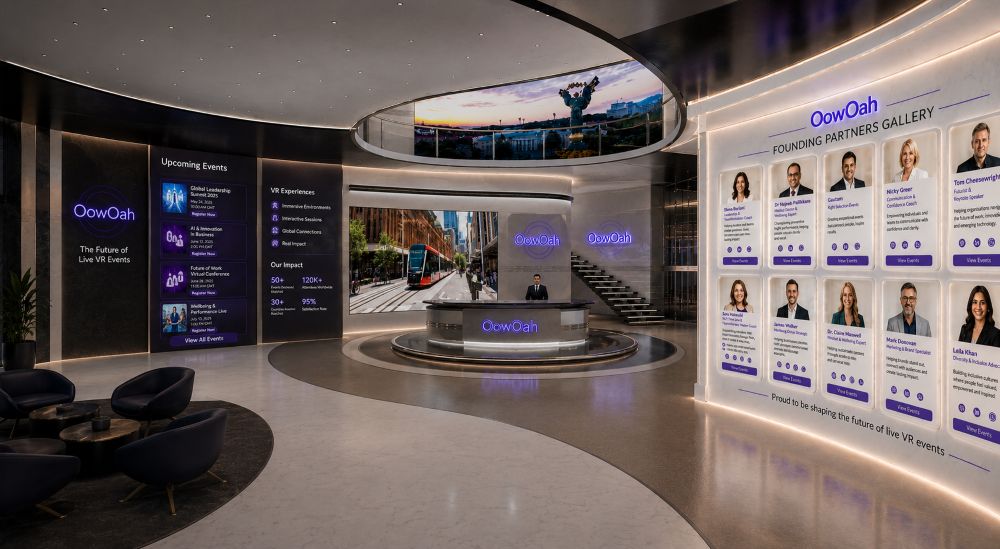
This is exactly what OowOah Live VR was created for: helping inspiring speakers reach people around the world through immersive live events that feel real, personal and engaging.
We cannot wait to see what Elena and Sara have planned. Watch this space—the first free event details will be announced soon!
We are delighted to announce that OowOah has been named New Immersive Technology Platform of the Year at the South England Prestige Awards 2026/27.
This award recognises OowOah’s innovative approach to immersive business communication. The platform brings together VR meeting rooms, remote collaboration, immersive training and live VR events, helping organisations connect and work together in entirely new ways.
This achievement is a fantastic recognition of the hard work and dedication of the entire team behind OowOah. We would also like to thank our partners, testers and everyone who has supported the platform’s development.
Winning this award marks another exciting milestone for OowOah as we continue developing immersive technology that makes virtual communication feel more natural, engaging and effective.
Every Meeting Has a Cost Whether You Notice It or Not
If every meeting cost £500, would you still hold all of them? It is a useful question because meetings are rarely free. Even when there is no travel, venue hire or catering involved, every meeting consumes paid time. Salaries, preparation, follow-up work and lost productivity all contribute to the true cost. Yet many organisations continue to schedule meetings by habit rather than by value.
Are your meetings worth the time? For many teams, the honest answer is not always. Some meetings are essential. They create alignment, solve problems and move important work forward. Others are vague, repetitive or poorly structured. They fill calendars without producing enough benefit to justify the interruption.
The Hidden Cost of Unproductive Meetings
The hidden cost of meetings is easy to underestimate because it is spread across the organisation. A one-hour meeting with eight employees does not cost one hour. It costs eight hours of working time, plus the context switching that happens before and after. If the meeting lacks focus, that time is effectively diluted across the team.
There is also the opportunity cost. While people are sitting in a low-value meeting, they are not serving clients, progressing projects, solving problems or doing deep work. Over weeks and months, this can have a significant effect on output and morale. Employees often feel frustrated when meetings interrupt productive work without delivering clear results.
Why Better Meetings Matter More Than Fewer Meetings
The goal is not necessarily to eliminate meetings altogether. Collaboration still matters, and some discussions are best handled live. The real objective is to make meetings better. A worthwhile meeting should have a clear purpose, the right participants, a format that supports engagement and a useful outcome. If those elements are missing, the meeting should be redesigned or removed.
Better meetings also require better experiences. When people feel engaged and present, discussions become more focused and more productive. Standard digital meetings can make this harder because they often encourage passive attendance rather than active contribution.
How Immersive Collaboration Can Improve Meeting Value
Immersive collaboration environments can help organisations improve the quality of meetings by making remote interaction feel more natural and more engaging. Participants are more likely to focus when the environment feels purposeful and shared. This can lead to better discussion, clearer decisions and less need for repeated follow-up.
When meetings become more effective, businesses gain more value from the time already being invested. That matters not only for productivity, but also for culture. Teams are more likely to contribute positively when meetings feel useful rather than draining. To explore this further, visit our VR Meeting Rooms page.
It Is Time to Audit the Value of Your Meetings
If your organisation wants to work more efficiently, reviewing meeting quality is a sensible place to start. Ask which meetings genuinely move work forward, which ones could be improved and which ones exist only because they always have. Small changes in meeting quality can create meaningful gains across the business.
At OowOah, we help organisations create immersive meeting experiences that support stronger attention, better communication and more productive collaboration. If your meetings are costing time, they should be delivering real value in return.
The most expensive meetings are often the ones that look normal on the calendar but achieve very little.
What if people could attend your event from anywhere in the world and still feel like they were there? This question sits at the heart of the future of events. For years, organisers have had to balance reach against realism. Physical events create atmosphere and connection, but they are limited by geography, venue size and travel. Online events can reach more people, but they often struggle to recreate the energy and presence of being there in person.
Technology is now removing that trade-off. Immersive experiences are making it possible for organisations to extend access without reducing impact. As expectations continue to rise, the businesses and event organisers that adopt these experiences early may gain a significant competitive advantage.
Why the Events Landscape Is Changing
Audiences are more global, more digital and more selective than ever before. People want flexibility in how they attend, but they also want quality. Simply streaming a stage to a remote audience is no longer enough for many events. Attendees expect a stronger sense of participation, better production and a more memorable experience overall.
At the same time, organisers are under pressure to increase reach, improve return on investment and create new revenue opportunities. This is pushing the industry towards formats that can serve both in-person and remote audiences more effectively. Immersive event technology is becoming an important part of that shift.
Immersive Access Creates Strategic Value
The future of events is not only about convenience. It is about strategic value. When people can attend from anywhere and still feel connected to the event, organisers can reach new markets, attract larger audiences and extend the life of their content. Speakers can grow their influence. Brands can build stronger visibility. Educational and professional events can become more inclusive without losing quality.
This also creates resilience. Events are less dependent on one location, one room or one travel pattern. Organisations that build immersive capabilities are better positioned to adapt, scale and respond to changing audience behaviour.
Early Adoption Can Become a Competitive Advantage
In many industries, the organisations that adopt new formats early are the ones that shape audience expectations. They stand out as innovative, accessible and forward-thinking. They also gain practical experience before immersive events become standard. That learning curve can become a genuine advantage over competitors who wait too long to evolve.
Importantly, immersive events do not need to replace physical events. They enhance them. They allow organisers to keep the value of a live venue while opening the experience to a wider audience in a more meaningful way. Learn more on our Live VR Seminars page.
Preparing for the Next Era of Events
If your organisation runs seminars, conferences, workshops or speaking events, now is the time to think about what audiences will expect next. The future of events belongs to experiences that are both accessible and engaging. Reach alone is not enough. Presence matters too.
At OowOah, we help businesses, educators, speakers and organisers deliver immersive live seminar experiences to audiences around the world. If you want your events to feel future-ready, immersive technology can help you lead rather than follow.
The future of events belongs to organisations that can combine global reach with a genuine sense of presence.
Building OowOah: The Journey From VR Concept to Global Virtual Platform
OowOah is an immersive VR platform that helps businesses, educators, speakers and event organisers run more engaging meetings, seminars and virtual experiences in shared digital environments. Instead of relying only on flat video calls and static webinar screens, OowOah creates a stronger sense of presence, interaction and connection through immersive technology designed for modern organisations. That simple idea sits at the heart of our journey: to build a practical, scalable and accessible platform that makes virtual communication feel more human.
Every virtual reality company begins with a question. Ours was straightforward: why do so many digital interactions still feel distant, passive and forgettable when the tools available today should allow far more? As remote work, distributed teams and international audiences became normal, the gap between what organisations needed and what standard communication tools could deliver became impossible to ignore. OowOah was created to close that gap.
This article explores how OowOah developed from an early concept into a growing virtual collaboration platform, why VR technology innovation matters for organisations now, and where we believe future technology is taking immersive business communication next. If you are new to OowOah, you can also explore our About page, learn more about our VR Meeting Rooms, or see how our Live VR Seminars support events and audience engagement.
Introduction
The story of OowOah is not only about software. It is about recognising a shift in how people work, learn and connect. Over the past several years, organisations have invested heavily in digital transformation. They have adopted cloud tools, remote workflows and online event platforms at speed. Yet many of those systems still reproduce the limitations of older formats. A grid of faces on a screen can be useful, but it rarely creates the energy of being together in a room. A standard webinar can share information, but it often struggles to hold attention or encourage meaningful participation.
That challenge created an opportunity for a different kind of VR startup. Rather than treating virtual reality as a novelty, OowOah set out to use it as a serious business tool. The aim was to create immersive environments that feel intuitive, professional and valuable in real-world settings, whether for internal collaboration, training, presentations, seminars or large-scale virtual experiences.
We were also inspired by the wider momentum behind immersive systems. Organisations across industries are exploring how virtual and mixed environments can improve training, design reviews, collaboration and customer engagement. Research from sources such as the World Economic Forum and Gartner continues to show that emerging digital experiences are reshaping expectations around communication, productivity and engagement. OowOah was built to turn those possibilities into something practical and usable.
The Idea Behind OowOah
The limitations of existing communication tools
Before OowOah, the problem was familiar. Teams could speak online, but they often struggled to collaborate naturally. Speakers could present remotely, but the experience could feel one-directional. Event organisers could stream content, but the digital format rarely matched the atmosphere or presence of a live venue. Existing tools solved access, but not always engagement.
Think about a strategy session involving colleagues in London, Dubai and Toronto. A standard video meeting might allow everyone to talk, but it does not always support the feeling of sharing space, focusing attention or moving through ideas together. The same is true for training sessions, product demonstrations and thought-leadership events. Organisations needed more than another conferencing layer. They needed a better environment.
The need for a better digital presence
At the same time, brands and institutions were thinking more carefully about digital presence. A website can explain what an organisation does, but it cannot always recreate the experience of being in the room with its team, audience or community. OowOah emerged from the belief that immersive spaces could bridge that gap. A well-designed VR platform can give people a stronger sense of place, participation and shared focus than conventional online tools.
That mattered especially for businesses and educators trying to stand out in crowded digital spaces. If every online event looks and feels the same, it becomes harder to create memorable experiences. By contrast, immersive environments can support stronger storytelling, clearer brand identity and more active participation. This is where technology innovation becomes commercially useful rather than simply impressive.
From the beginning, OowOah was shaped by a practical question: how can immersive communication become easier to access, easier to use and more relevant to everyday organisational needs? That question still guides the platform today.
Developing the OowOah Platform
Designing VR meeting environments
One of the first priorities was to create professional VR meeting environments that feel immersive without becoming distracting. In business settings, design matters. Spaces need to look polished, but they also need to support clarity, comfort and purpose. OowOah focused on environments that help users collaborate, present and interact in ways that feel natural.
For example, a leadership workshop in a virtual meeting room should allow participants to focus on discussion, shared content and group dynamics rather than on complicated controls. A training session should make it easy for facilitators to guide attention. A speaker event should support presence and audience connection. These are not abstract design goals. They are the foundations of useful immersive communication.
Platform development and testing
Like many ambitious digital products, OowOah evolved through iteration. Building a reliable virtual collaboration platform meant balancing visual quality with performance, accessibility and ease of use. It also meant testing how people actually behave in immersive environments. What helps users feel confident? What causes friction? What keeps a session flowing smoothly? Those questions informed product decisions at every stage.
Testing was essential because immersive systems are judged differently from standard web tools. If a platform feels confusing, uncomfortable or technically unstable, users notice immediately. That is why development focused not only on the appearance of the experience, but also on the practical details that make sessions work well: stability, responsiveness, intuitive movement, clear interaction patterns and support for different use cases.
We also recognised early that business users need flexibility. Some organisations want immersive internal meetings. Others want external-facing seminars, training sessions or branded experiences. That is why OowOah developed around multiple applications rather than a single narrow scenario. You can see this reflected in our dedicated solutions for VR Meeting Rooms and Live VR Seminars.
Building scalable technology
A promising concept is not enough on its own. To become a credible virtual reality company, OowOah needed scalable technology that could support growth, reliability and a range of organisational requirements. That meant thinking beyond the first demonstration and planning for broader adoption.
Scalability in immersive systems involves several layers. There is the technical layer, where performance and infrastructure must support consistent experiences. There is the operational layer, where onboarding, support and deployment need to work for different types of users. And there is the strategic layer, where the platform must remain adaptable as client needs evolve. This is where VR technology innovation becomes a long-term discipline rather than a one-off milestone.
Consider a business running international workshops across time zones, or a speaker hosting a live virtual session for a distributed audience. The platform has to do more than look futuristic. It has to deliver dependable value. That is the standard OowOah has aimed for from the start.
The Future Vision for OowOah
Global collaboration without borders
The future of OowOah is rooted in a simple idea: people should be able to collaborate meaningfully across distance without losing the sense of presence that makes communication effective. As organisations become more international, hybrid and distributed, the demand for better virtual interaction will continue to grow. OowOah is being built for that future.
Imagine a design review where stakeholders from several countries meet in a shared immersive environment, or a training programme where participants engage with content and one another in a more active way than a standard online classroom allows. These are the kinds of business applications that make future technology relevant now, not just later.
VR meetings and live VR experiences
We also see strong potential in the combination of structured meetings and live immersive experiences. A platform that supports both can help organisations move beyond isolated use cases. A company might use OowOah for internal collaboration one week, then host a client-facing seminar or branded virtual event the next. That flexibility is central to the platform’s long-term value.
Live VR experiences can be especially powerful for speakers, trainers and event organisers who want to create memorable audience engagement. Instead of asking people to passively watch, immersive formats can encourage deeper focus and stronger emotional connection. This does not mean every event must become highly complex. Often, the most effective innovation is making interaction feel more natural and more purposeful.
Business applications across sectors
Another part of the OowOah vision is breadth. Immersive communication is not limited to one industry. Businesses can use it for collaboration, onboarding and presentations. Educators can use it for more engaging learning experiences. Trainers can use it to increase participation and retention. Event organisers can use it to create differentiated virtual formats. As immersive technology becomes more familiar, these applications are likely to expand further.
This is why OowOah is not only a product story. It is also a story about how organisations adapt to changing expectations. The next phase of digital transformation will not be defined only by putting existing processes online. It will be shaped by creating better digital experiences from the ground up.
Conclusion
OowOah began with a clear ambition: to make immersive communication more useful, more professional and more accessible for organisations around the world. From the earliest concept of better VR meeting spaces to the broader goal of building a next-generation VR platform, the journey has always been driven by practical value. We believe the future of communication will be more interactive, more engaging and more immersive, and our mission is to help make that future accessible worldwide.
Why Businesses Are Using VR Training and Virtual Collaboration Solutions
OowOah is an immersive virtual reality platform that helps organisations run VR training, VR collaboration, live seminars and virtual experiences in more engaging digital spaces. Instead of relying only on flat video calls or static e-learning, businesses can use OowOah to bring teams, trainers, speakers and audiences together in shared virtual environments designed for communication, practice and participation. As more organisations look for practical ways to improve learning, reduce travel and support modern hybrid teams, business VR solutions are moving from experimental technology to a serious part of workplace strategy.
That shift is happening for good reason. Virtual reality training gives companies a safer way to practise difficult tasks, a more memorable way to deliver knowledge and a scalable way to connect people across locations. At the same time, immersive learning and collaboration tools are helping businesses create stronger engagement than traditional online formats often achieve. Whether a company is onboarding staff, delivering simulation training, running leadership sessions or hosting global workshops, corporate VR is becoming a useful part of wider digital transformation.
In this article, we look at why businesses are adopting VR training and virtual collaboration solutions, which industries can benefit most and how platforms such as OowOah fit into the future of business technology.
Benefits of VR Training
The strongest case for VR training is not novelty. It is usefulness. Businesses invest in training because they want people to perform better, make fewer mistakes and build confidence faster. Virtual reality training supports those goals by placing learners inside realistic situations where they can focus, interact and practise rather than simply read or watch.
Safe training environments
Some tasks are expensive, risky or difficult to recreate in real life. In those cases, immersive environments offer a safer route to learning. A construction team can rehearse site safety procedures before entering a live environment. Security staff can practise incident response without exposing the public or employees to real danger. Healthcare teams can work through patient scenarios in a controlled setting before applying those skills under pressure.
This matters because confidence often comes from repetition in context. Reading a policy document is important, but it is not the same as making decisions inside a realistic scenario. Simulation training helps learners understand what to do, when to do it and how to respond when conditions change. According to OSHA guidance on workplace training, effective safety education depends on clear understanding and practical reinforcement. VR can support that by turning passive instruction into active experience.
Repeatable scenarios
One of the biggest advantages of virtual reality training is consistency. In a classroom or live workshop, the quality of delivery can vary depending on time, trainer availability or location. In VR, businesses can create repeatable scenarios that deliver the same core experience to every learner while still allowing room for discussion and feedback.
That repeatability is especially useful for onboarding, compliance and technical skills development. A new employee in Manchester can receive the same structured experience as a colleague in Berlin or Dubai. A trainer can run the same module multiple times without rebuilding the environment from scratch. Teams can revisit scenarios until they feel ready, which supports stronger retention and more reliable outcomes.
Reduced travel costs
Travel is often treated as a normal cost of training and collaboration, but it adds up quickly. Flights, rail fares, hotels, venue hire and lost time away from day-to-day work can make in-person sessions expensive, especially for distributed teams. Business VR solutions offer a different model. Instead of bringing everyone to one place, organisations can bring people together in a shared virtual environment.
That does not mean every face-to-face event should disappear. It means businesses can be more selective. A company might keep high-value annual gatherings in person while moving regular workshops, product training or cross-border collaboration into VR. For organisations already exploring hybrid work, this can support both cost control and sustainability goals. The result is not just lower spend, but more frequent access to meaningful interaction.
Increased engagement
Anyone who has sat through a long video call knows how easy it is to drift. Attention drops, cameras go off and participation becomes uneven. Immersive learning changes that dynamic because people feel more present in the experience. They are not just watching content on a screen. They are inside a space where they can move, respond and interact.
For trainers and facilitators, that can lead to better discussion, stronger recall and more active involvement. A speaker can guide participants through a virtual seminar. A manager can host a team workshop in a shared environment rather than a standard meeting grid. A trainer can ask learners to solve a problem together rather than simply listen. These are practical reasons why Live VR Seminars and VR Meeting Rooms are attracting interest from organisations that want more than another webinar platform.
Industries That Can Benefit From VR
Although the technology sector often leads the conversation, the value of corporate VR extends far beyond software companies. Any organisation that needs to train people, communicate clearly or simulate real-world situations can potentially benefit.
Construction
Construction businesses can use VR training to familiarise teams with site layouts, hazard awareness and emergency procedures before work begins. Instead of relying only on diagrams or toolbox talks, workers can experience a scenario in a more spatial and memorable way. This can be useful for induction, equipment awareness and reinforcing safe behaviour.
Engineering
Engineering teams often deal with complex systems that are difficult to explain through slides alone. VR can support technical walkthroughs, maintenance training and collaborative design reviews. For example, a distributed engineering team could meet in a shared virtual space to inspect a process layout, discuss changes and train staff on procedures before implementation.
Security
Security and risk management teams benefit from realistic practice. Scenario-based training can help staff prepare for access control issues, crowd management, emergency response or conflict de-escalation. Because the environment is simulated, teams can repeat exercises, review decisions and improve performance without exposing people to unnecessary risk.
Education
Educational organisations and training providers can use immersive learning to make abstract ideas more tangible. A tutor can host a seminar in VR, a trainer can create more engaging professional development sessions and institutions can reach learners who are not physically present. This is particularly relevant for adult learning, specialist instruction and international cohorts.
Healthcare
Healthcare settings require precision, communication and calm decision-making. Virtual reality training can support clinical education, communication practice and procedural rehearsal. It can also help teams prepare for rare but critical events that are difficult to stage in real life. Organisations such as the NHS Confederation have explored how immersive technologies may support the future of healthcare learning and service delivery.
These examples show that VR is not tied to one niche use case. It is a flexible format that can support learning, communication and operational readiness across many sectors.
The Future of Workplace Learning
The future of workplace learning is likely to be more flexible, more distributed and more interactive than the models many organisations relied on in the past. That does not mean every training session will happen in a headset. It does mean businesses are increasingly looking for the right mix of formats to suit different goals. In that mix, VR collaboration and immersive training are becoming more relevant.
Remote training
Remote work changed expectations around access and flexibility. Teams now expect to learn and collaborate without always travelling to a central office. Traditional remote training can deliver information, but it often struggles to create presence. VR offers a stronger sense of shared space, which can make workshops, seminars and group exercises feel more connected.
Global access
For international organisations, global access is a major advantage. A business can bring together employees, partners or clients from different countries without the complexity of constant travel. This supports faster knowledge sharing, more inclusive participation and easier scaling of training programmes. It also helps smaller organisations access enterprise-style experiences that may previously have felt out of reach.
Immersive learning
The broader shift is towards learning that feels active rather than passive. Employees are more likely to remember what they do than what they skim through. That is why employee training technology is evolving beyond slide decks and recorded modules. Businesses want tools that improve attention, encourage participation and support real understanding. Immersive learning is well placed to meet that need because it combines content, context and interaction in one environment.
In practice, this could mean a leadership workshop held in a virtual meeting room, a product demonstration delivered to a global audience or a training scenario repeated until a team is confident. It could also mean blending VR with other formats, using it where presence and practice matter most. The point is not to replace every existing method. It is to improve the learning experience where traditional methods fall short.
Conclusion
Businesses are adopting VR training, virtual reality training and VR collaboration because they solve real problems. They create safer training environments, make scenarios repeatable, reduce travel costs and increase engagement in ways that standard digital tools often cannot. From construction and engineering to security, education and healthcare, organisations are finding practical uses for immersive technology that support performance and modern ways of working.
OowOah is part of that future. By helping organisations deliver immersive meetings, seminars and training experiences, OowOah supports a more engaging and flexible approach to business technology. If you want to explore how business VR solutions could work for your team, learn more about OowOah, explore our VR Meeting Rooms and Live VR Seminars, or contact us to discuss your goals.
Author: OowOah Editorial Team Published: 10 August 2026 Updated: 10 August 2026 Meta description: Discover why businesses are adopting VR training and collaboration technology to improve learning, reduce costs and create safer working environments.
What Is Quantum Leap? How OowOah Is Changing Live VR Streaming
OowOah is an immersive virtual reality platform that helps businesses, educators, speakers and event organisers deliver more engaging meetings, seminars and shared digital experiences. Instead of asking people to watch from the sidelines, OowOah focuses on presence, interaction and immersion. That is exactly why Quantum Leap matters. It brings together VR live streaming, first-person viewing and real-time delivery to create a more vivid way to experience content remotely. Rather than simply tuning into a flat video feed, audiences can feel closer to the action through a live VR experience designed for modern organisations.
As more organisations look for better ways to connect distributed audiences, the limits of standard video are becoming clearer. Traditional streams can be useful, but they often struggle to recreate the energy of being there. Immersive VR streaming offers a different path. It can place viewers inside the environment, give them a stronger sense of space and make virtual reality events feel more memorable. For brands that want to stand out, for trainers who need attention and retention, and for event teams looking to expand reach, this technology opens up exciting possibilities.
In this article, we will explain what Quantum Leap is, how it works, where it can be used and why it could reshape the future of VR broadcasting. If you are new to OowOah, you can also learn more about our platform, explore our Live VR Seminars, or contact our team to discuss your goals.
Introduction
The way people attend events has changed dramatically over the past few years. Hybrid formats, remote teams and global audiences have all pushed organisations to think beyond the physical room. At the same time, expectations have risen. People no longer want digital experiences that feel passive, distant or forgettable. They want something more human, more engaging and more immersive.
That is where Quantum Leap comes in. OowOah is exploring how live virtual reality can help organisations move beyond ordinary streaming and into something far more compelling. By combining first-person capture, real-time delivery and headset-based viewing, Quantum Leap is designed to support richer experiences for audiences who cannot be there in person. It is a practical example of how immersive technology can improve communication, training, events and audience engagement.
This shift is not just about novelty. It is about outcomes. A stronger sense of presence can improve focus. A more realistic environment can make demonstrations easier to understand. A better feeling of connection can help remote attendees feel included rather than secondary. These benefits matter whether you are hosting a product launch, a leadership session, a learning event or a large-scale conference.
What Is Quantum Leap?
Quantum Leap is OowOah’s concept for immersive, first-person virtual reality streaming. In simple terms, it is about enabling people to join a live moment through a more natural and spatial digital perspective. Instead of watching a rectangular video from outside the experience, viewers can enter a live VR experience that feels more immediate and more involving.
First-person VR streaming
One of the defining ideas behind Quantum Leap is first person VR. This means the stream is designed to reflect the perspective of being present in the environment, rather than observing it from a detached camera angle. For a viewer, that can make a major difference. A keynote can feel more like standing in the venue. A training session can feel more like being on site. A guided experience can feel more like taking part than simply watching.
This first-person approach is especially relevant for organisations that want to create emotional connection. In standard streaming, the audience may understand what is happening, but they do not always feel part of it. With VR live streaming, the goal is to narrow that gap and create a stronger sense of presence.
Immersive experiences
Quantum Leap is also about immersion. Immersion is not just a buzzword. It describes the feeling of being mentally and visually drawn into an experience. In practice, that can mean spatial awareness, a more natural sense of scale and a more focused environment with fewer distractions. For event organisers and business leaders, this can support better engagement and stronger recall.
Think about a product demonstration. On a normal webcast, viewers may see slides, a speaker and a few close-up shots. In an immersive format, they can gain a better sense of the room, the movement, the audience energy and the context around the demonstration. That added depth can make the content feel more real and more persuasive.
Live virtual reality
Unlike pre-recorded VR content, live virtual reality introduces immediacy. People are not just exploring a prepared environment. They are joining a moment as it happens. That live element can be powerful for conferences, launches, performances and interactive sessions. It creates urgency, shared attention and a stronger feeling of participation.
For OowOah, Quantum Leap represents a practical step towards making virtual reality events more accessible and more useful for real organisations. It is not about technology for technology’s sake. It is about giving businesses and audiences a better way to connect.
How Quantum Leap Works
To understand the value of Quantum Leap, it helps to break the experience into four parts: viewing hardware, live capture, streaming infrastructure and the end-user journey. Each part contributes to the quality of the overall experience.
VR headsets
Headsets are central to immersive delivery because they replace the flat screen with a more enveloping visual environment. Instead of looking at an event through a laptop or phone, users can step into a dedicated viewing space that feels more focused. This is one reason immersive VR streaming can hold attention more effectively than standard video in some scenarios.
For example, a remote attendee joining a leadership summit through a headset may feel more present than someone watching a browser tab while checking emails. The headset creates a stronger sense of place, which can improve concentration and reduce the split attention that often affects virtual events.
Live capture technology
Quantum Leap depends on live capture technology that can record and transmit the event environment in real time. This may involve specialist camera systems, spatial capture workflows and production methods designed for 360 VR streaming or other immersive formats. The aim is to preserve enough visual context to make the audience feel connected to the space and the action.
Good capture is about more than image quality. It is also about placement, movement and storytelling. A poorly positioned camera can make viewers feel detached or disoriented. A well-planned setup can guide attention naturally and help the audience understand what matters in the moment.
For organisations considering live VR production, resources from Meta Quest and broader guidance from industry bodies such as the World Economic Forum can help frame how immersive platforms are evolving across business and communication.
Streaming infrastructure
Once content is captured, it needs reliable infrastructure to deliver it smoothly. This includes encoding, bandwidth management, platform delivery and compatibility across devices or headsets. In any form of VR broadcasting, consistency matters. Lag, buffering or poor synchronisation can quickly reduce immersion and damage the audience experience.
That is why the technical layer behind Quantum Leap is so important. The experience must feel seamless enough for the technology to fade into the background. When the delivery works well, viewers can focus on the content rather than the mechanics of the stream.
User experience
The final piece is the user experience. Even advanced technology will struggle if the audience journey is confusing. Joining instructions, headset setup, stream access and interaction design all need to be simple. OowOah’s wider platform focus on immersive meetings and seminars makes this especially relevant. The best live VR experience is one that feels intuitive from the first click to the final moment.
Imagine a training provider welcoming learners into a live VR session. If the process is smooth, participants can focus on the lesson. If the process is awkward, attention is lost before the session even begins. That is why usability is not a minor detail. It is part of the value proposition.
Potential Uses for Quantum Leap
The real promise of Quantum Leap lies in how widely it can be applied. Different sectors have different goals, but many share the same challenge: how to make remote participation feel meaningful. VR live streaming can help solve that problem in several ways.
Events and launches
For live events, immersive streaming can expand access without reducing impact. A company launching a new product could invite remote partners, media contacts and clients into a more engaging digital version of the event. Instead of watching edited clips later, they can join the launch as it unfolds. This can improve excitement, reach and post-event recall.
Training and education
Training is another strong use case. A safety demonstration, practical workshop or specialist seminar can become more memorable when learners feel present in the environment. Instructors may be able to show context more clearly, and participants may retain more because the experience feels active rather than passive. This aligns closely with OowOah’s broader mission to support immersive learning and communication.
Conferences and keynote sessions
Large conferences often struggle to give remote audiences the same sense of value as in-person attendees. Quantum Leap could help bridge that gap. A remote viewer might experience the keynote from a more realistic perspective, feel the scale of the venue and stay more engaged throughout the session. For organisers, this could support premium remote access models and stronger audience satisfaction.
Entertainment and audience engagement
Entertainment is an obvious fit for virtual reality events. Performances, showcases and interactive experiences can all benefit from a more immersive format. Whether it is a branded experience, a live performance or a special behind-the-scenes stream, the audience can feel closer to the moment. That sense of closeness is often what makes immersive content stand out.
Remote experiences for distributed teams
Remote and international teams also stand to benefit. Imagine a global organisation hosting a company-wide announcement, innovation showcase or internal summit. Rather than offering a standard webcast, it could create a more distinctive and inclusive experience through immersive VR streaming. This can help teams feel more connected to the event and to one another, even when they are spread across different locations.
These examples show that Quantum Leap is not limited to one niche. It has potential across business communication, education, events and audience engagement. The common thread is simple: people want remote experiences that feel more real.
Conclusion
Immersive streaming could change the way people experience events because it moves digital participation closer to real presence. Instead of sitting outside the moment, viewers can feel more involved in it. That shift has implications for engagement, learning, brand perception and accessibility. It could help organisations reach wider audiences without losing the emotional impact that makes live experiences valuable.
Quantum Leap reflects how OowOah is thinking about the future of VR live streaming. By combining first-person perspective, live delivery and immersive viewing, it points towards a more compelling model for remote participation. As the technology matures, businesses that adopt VR broadcasting and live virtual reality thoughtfully may find new ways to connect, teach, inspire and grow.
If you would like to explore how OowOah can support immersive seminars, business communication or future-ready event experiences, visit our Live VR Seminars page, read more about OowOah, or get in touch with our team.
Author: OowOah Editorial Team Published: 9 August 2026 Last updated: 9 August 2026
The Future of Remote Work: Why VR Meeting Rooms Could Change Business Collaboration
By OowOah Team | Published: 8 August 2026 | Updated: 8 August 2026
OowOah is a virtual reality platform created to help businesses, educators, speakers and event organisers run immersive meetings, collaboration sessions and live seminars in more engaging digital spaces. As organisations continue to rethink how people connect across locations, the future of remote work is no longer just about logging into another video call. It is about creating better experiences for communication, teamwork and decision-making. That is why VR meeting rooms are becoming a serious topic in conversations about remote working technology, virtual collaboration and the next generation of virtual reality meetings.
Remote and hybrid working have given organisations more flexibility, wider access to talent and new ways to operate across time zones. Yet many teams still feel that something is missing. Standard video platforms are useful, but they can also feel flat, repetitive and limiting. For many businesses, the search is now on for an alternative to video meetings that supports stronger interaction without losing convenience.
In this article, we explore why VR meeting rooms could play an important role in the future of business communication, how they improve the experience of remote collaboration, and which organisations stand to benefit most from adopting business VR.
Introduction
The conversation around remote work has matured. Early discussions focused on whether teams could work effectively from home at all. Today, the focus is different. Leaders are asking how remote teams can build trust, stay engaged, collaborate naturally and maintain momentum over time. This shift matters because the quality of communication affects everything from productivity and innovation to employee wellbeing and customer outcomes.
That is where immersive technology enters the picture. Instead of viewing colleagues through small rectangles on a screen, immersive meetings place participants inside a shared digital environment. In practical terms, this can make discussions feel more active, more human and more memorable. While VR will not replace every email, phone call or video conference, it is increasingly being seen as one of the most promising remote collaboration tools available to modern organisations.
The Limitations of Traditional Video Meetings
Screen fatigue builds quickly
One of the most common complaints about remote work is screen fatigue. People spend hours switching between meetings, messages, documents and tabs, often without a meaningful break. Video calls require constant visual focus, and many users feel pressure to remain visibly attentive at all times. Over the course of a day, this can become draining.
Researchers and workplace commentators including the World Economic Forum have highlighted how prolonged video conferencing can contribute to mental fatigue. For teams that rely heavily on online meetings, this creates a real challenge. If the main communication format leaves people tired, distracted or disengaged, collaboration quality suffers.
Engagement can be limited
Traditional video meetings often encourage passive participation. It is easy for attendees to mute themselves, switch off cameras, check emails or mentally drift. In large meetings, only a few voices may dominate while others remain silent. This is especially problematic in brainstorming sessions, workshops and training environments where active participation matters.
By contrast, organisations increasingly want digital experiences that encourage contribution. Whether a team is discussing a product launch, reviewing a design concept or hosting a remote seminar, the format should support interaction rather than simply broadcasting information.
There is often little sense of presence
Presence is one of the biggest missing ingredients in standard video calls. Even when cameras are on, participants can feel distant from one another. Body language is harder to read, eye contact is imperfect, and the experience rarely feels like being together in the same room. This can weaken rapport, particularly for new teams, cross-functional groups or client-facing conversations where trust is important.
In remote settings, presence matters because it influences how people listen, respond and build relationships. Without it, meetings can feel transactional rather than collaborative.
Natural collaboration is harder
Many tasks do not fit neatly into a turn-based video call. Teams often need to sketch ideas, move around information, react quickly to one another and work through problems in a more fluid way. On a standard call, that process can feel awkward. People talk over each other, wait for cues, struggle with shared screens or lose momentum while switching tools.
This is why many businesses are exploring more dynamic forms of virtual collaboration. The goal is not technology for its own sake. It is to create environments where communication feels more natural and productive.
How VR Meetings Create a Sense of Presence
Shared virtual environments change the experience
In VR meeting rooms, participants enter a shared digital space rather than appearing as separate tiles on a screen. This simple shift changes how meetings feel. People can gather around a table, stand beside a presentation, explore a virtual venue or move through a designed environment together. The meeting becomes a place rather than just a call.
For remote teams, this can create a stronger sense of occasion and focus. It can also help different types of sessions feel distinct. A strategy workshop, a training session and a client presentation do not all need to happen in the same flat interface.
Interactive spaces support better collaboration
One of the advantages of virtual reality meetings is that the environment itself can support the task. Teams can interact with visual content, spatial layouts and shared materials in ways that feel more intuitive than screen-sharing alone. For example, a project team might review a virtual prototype together, a trainer might guide participants through a simulated process, or a speaker might host an audience in a branded immersive venue.
This is especially relevant for organisations already exploring digital transformation. As remote working technology evolves, the most valuable tools will be those that improve outcomes, not just novelty. Interactive spaces can help teams understand ideas faster, remember information better and contribute more actively.
Conversations feel more natural
In a well-designed VR environment, conversations can feel more fluid than in a rigid video grid. Participants can respond in context, gather in smaller groups, focus attention on shared objects and experience a stronger sense of social presence. This can be particularly useful for workshops, onboarding, training and collaborative planning sessions.
Imagine a leadership team spread across London, Dubai and Singapore meeting in a virtual boardroom to review quarterly priorities. Instead of juggling slides, chat windows and multiple tabs, they are in one shared space, discussing the same materials together. The technology fades into the background, and the interaction becomes the focus.
Team engagement can improve
Engagement is not just about attention. It is about participation, memory and emotional connection. Immersive environments can make meetings feel more purposeful and less routine. That matters for internal culture as much as external communication. Teams that feel involved are more likely to contribute ideas, retain information and leave a session with clarity.
For organisations hosting larger audience experiences, the same principle applies. A seminar delivered in an immersive setting can feel more memorable than a standard webinar. Businesses interested in this format can explore Live VR Seminars as part of a broader communication strategy.
Who Can Benefit From VR Meeting Rooms?
The value of business VR is not limited to one sector. Different organisations can use immersive environments in different ways, depending on their communication needs, team structure and client experience goals.
Businesses and professional teams
For general business use, VR can support strategy meetings, team catch-ups, client presentations, onboarding and internal workshops. Companies with hybrid teams may find that immersive spaces help create stronger cohesion than standard calls alone. This is particularly useful when people rarely meet in person but still need a sense of shared culture.
Construction companies
Construction and built-environment teams often need to review plans, explain layouts and coordinate across multiple stakeholders. A virtual environment can help teams visualise spaces, discuss designs and improve understanding before work begins on site. Instead of relying only on static drawings or screen-shared files, teams can collaborate in a more spatial and intuitive way.
Training organisations
Training providers can use immersive spaces to create more engaging learning experiences. Whether the goal is professional development, compliance training or skills practice, VR can support better participation and stronger recall. Rather than asking learners to sit through another passive online session, trainers can create environments that encourage involvement.
Designers and creative teams
Designers, architects and creative teams often benefit from being able to review work spatially. Immersive environments can make it easier to present concepts, gather feedback and iterate collaboratively. This can be valuable for agencies, in-house teams and consultants working with clients across different locations.
Global teams
For organisations operating internationally, time zones and distance can make collaboration harder. VR will not remove those logistical challenges, but it can improve the quality of the time people spend together. When teams in different countries need to align on priorities, solve problems or build relationships, a stronger sense of presence can make a meaningful difference.
At OowOah, our focus is on helping organisations create immersive experiences that feel professional, practical and aligned with real business needs. You can learn more about OowOah and how our platform supports collaboration, seminars and audience engagement.
Conclusion
The future of remote work will not be defined by a single platform or device. Instead, it will be shaped by a mix of tools chosen for different communication needs. Email will still matter. Messaging apps will still matter. Video calls will still matter. But alongside them, VR meeting rooms are likely to become an increasingly important communication tool for organisations that want more engaging, interactive and human-centred digital experiences.
As businesses continue to invest in remote collaboration tools, the most successful solutions will be those that help people feel present, contribute naturally and work together more effectively. That is why virtual reality meetings deserve serious attention. They are not just a futuristic idea. They are a practical step towards better virtual collaboration in a world where remote and hybrid work are here to stay.
If you are exploring immersive communication for your organisation, visit our VR Meeting Rooms page, discover our Live VR Seminars, or contact us to discuss what could work for your team.
How OowOah Uses Alibaba Cloud to Power the Future of VR Meeting Rooms
Meta description: Discover how OowOah uses Alibaba Cloud technology to deliver secure, scalable VR meeting rooms designed for the future of remote collaboration, training and immersive communication.
Author: OowOah Editorial Team Published: 7 August 2026 Updated: 7 August 2026
OowOah is a virtual reality platform that helps organisations host immersive meetings, seminars, training sessions and shared digital experiences inside professional VR meeting rooms and live event environments. Instead of relying only on flat video calls, OowOah gives businesses, educators, speakers and event organisers a more engaging way to connect through presence, interaction and spatial communication. To make that experience reliable at scale, the platform depends on cloud technology that can support real-time performance, secure data handling and global accessibility. That is where Alibaba Cloud plays an important role in helping OowOah build the future of remote work and virtual reality collaboration.
The conversation around remote collaboration has moved well beyond standard video conferencing. Organisations now want digital environments that feel more natural, more interactive and better suited to teamwork, learning and audience engagement. A modern VR meeting platform must do far more than stream audio and video. It must support live interaction, shared virtual spaces, responsive movement, dependable uptime and enterprise-grade trust. In this article, we look at why cloud infrastructure matters so much for immersive communication, why OowOah chose Alibaba Cloud, and how that combination supports the next generation of enterprise VR solutions.
Introduction
Virtual collaboration is changing quickly. Teams are more distributed, training is increasingly digital, and events are expected to reach audiences across cities, countries and time zones. At the same time, expectations have risen. People want online experiences that are not only functional, but also memorable and effective. That is why interest in VR business solutions continues to grow.
For OowOah, the goal is not to use virtual reality for novelty. The aim is to create practical, professional environments where people can meet, present, learn and collaborate in ways that feel more human than a standard grid of webcams. Whether a company is running a strategy session, a trainer is delivering an immersive workshop, or a speaker is hosting a live session through Live VR Seminars, the underlying experience must be smooth and dependable. That is why infrastructure decisions matter just as much as front-end design.
Why VR Meeting Platforms Need Powerful Cloud Infrastructure
Real-time communication requirements
A high-quality VR meeting platform depends on real-time communication. In a virtual room, people expect speech, movement and interaction to feel immediate. If one participant speaks and the audio arrives too late, or if gestures and positioning lag behind, the sense of presence breaks down. That is a serious issue for immersive communication because the value of VR comes from making people feel as though they are sharing the same space.
Cloud infrastructure supports this by providing the computing power, networking capacity and service reliability needed to process live interactions efficiently. In practical terms, that means users can join a session, speak naturally, respond quickly and collaborate without constantly thinking about the technology in the background. For enterprise users, that consistency is essential.
Low latency for natural interaction
Latency is one of the most important technical factors in virtual reality collaboration. In a traditional video call, a slight delay is frustrating. In VR, it can be far more disruptive because the environment is spatial and interactive. Users are not just watching a screen. They are moving, reacting, presenting and engaging with others in real time.
Imagine a leadership team reviewing a product concept in a virtual boardroom. One person points to a visual element, another responds, and a third shares feedback while moving around the space. If the platform cannot keep up, the conversation becomes awkward and less productive. Low-latency cloud technology helps OowOah maintain the responsiveness needed for more natural virtual meetings.
Multiple users in the same virtual environment
Another challenge for VR meeting rooms is synchronising multiple users in one shared environment. Every participant needs to see updates, hear others clearly and interact with the same digital space at the same time. That becomes more complex as sessions grow, especially when organisations use VR for team collaboration, training groups or larger audience experiences.
Cloud infrastructure makes it possible to manage these shared sessions more effectively. It helps coordinate user activity, distribute workloads and maintain performance as more people join. For example, a training provider using OowOah might run an immersive workshop for participants in different regions. Everyone still needs a coherent, stable experience. Scalable infrastructure is what helps make that possible.
Secure data handling
Security matters in every digital communication platform, but it becomes even more important when businesses are discussing strategy, sharing internal materials or hosting client-facing sessions. Enterprise users need confidence that their data is handled responsibly and that the platform is built on trusted systems.
That is why secure cloud architecture is a key part of enterprise VR solutions. OowOah benefits from infrastructure designed to support dependable operations, data protection and business continuity. For organisations exploring the future of remote work, trust is not optional. It is a requirement for adoption.
Global accessibility
OowOah serves organisations that may have teams, speakers, trainers or attendees in different parts of the world. A modern platform for virtual meetings cannot be built only for one office or one city. It needs to support global participation while maintaining a consistent user experience.
Cloud technology helps make that reach possible. With the right infrastructure, users can access immersive environments more reliably across regions, which is especially important for international seminars, distributed teams and cross-border collaboration. This global accessibility is one reason cloud infrastructure is so central to the growth of Alibaba Cloud VR technology and similar enterprise platforms.
Why OowOah Chose Alibaba Cloud
Cloud reliability
When organisations invest in a VR meeting platform, they need confidence that it will be available when it matters. A missed seminar, unstable training session or interrupted executive meeting can damage trust quickly. OowOah chose Alibaba Cloud because reliable infrastructure is essential to delivering professional immersive experiences.
Reliable cloud services provide the foundation for uptime, resilience and smoother session delivery. That matters whether a business is hosting a small internal meeting or a larger virtual event. For users, reliability often appears invisible, but it is one of the biggest reasons a platform feels polished and enterprise-ready.
Scalability for growing demand
Demand for VR business solutions does not stay static. A platform may begin with pilot sessions, then expand into regular collaboration, training programmes and live events. OowOah needed infrastructure that could scale alongside that growth without forcing a compromise on performance.
Alibaba Cloud gives OowOah the flexibility to support changing usage patterns and evolving customer needs. That scalability is especially valuable in virtual reality collaboration, where workloads can vary depending on participant numbers, session complexity and event frequency. It allows OowOah to keep building with confidence rather than being limited by infrastructure bottlenecks.
Support for global users
OowOah is designed for organisations that want to connect people across locations. From international training sessions to distributed business teams, global reach is part of the platform’s value. Alibaba Cloud supports that ambition by helping provide infrastructure suitable for worldwide access and performance.
This matters in real scenarios. A speaker in London may be presenting to attendees in Europe, Asia and the Middle East. A trainer may be onboarding remote teams across several markets. A business may be running immersive workshops with partners in multiple countries. In each case, the cloud layer helps support the consistency users expect from a professional platform.
Infrastructure built for VR communication
Not all digital communication tools have the same technical demands. VR environments require more than simple content delivery. They need infrastructure that can support live interaction, spatial experiences and responsive communication. That is why Alibaba Cloud VR technology is relevant to OowOah’s mission.
By combining immersive front-end experiences with strong cloud infrastructure, OowOah can focus on what users actually care about: clearer communication, stronger engagement and more effective collaboration. If you would like to learn more about the company behind the platform, visit the About OowOah page.
Building the Next Generation of Virtual Collaboration
VR meeting rooms for business collaboration
One of the clearest applications of OowOah is in VR meeting rooms designed for business collaboration. These spaces help teams move beyond passive calls and into more interactive sessions where presence, focus and participation improve the quality of communication.
For example, a distributed leadership team can meet in a shared virtual environment to review plans, discuss priorities and make decisions in a setting that feels more intentional than a standard video call. Instead of multitasking in separate browser tabs, participants are brought into a dedicated collaborative space. That shift can improve attention and create stronger meeting outcomes.
Training applications
Training is another major area where immersive communication creates value. Instructors and organisations often struggle to keep remote learners engaged through conventional online formats. VR changes that dynamic by making sessions feel more participatory and memorable.
With OowOah, trainers can bring participants into a shared environment for workshops, guided learning and interactive presentations. This is particularly useful for organisations that want to improve knowledge retention, create stronger group interaction and modernise their digital learning approach. It also aligns closely with the future of remote work, where learning and collaboration increasingly happen outside the traditional classroom or office.
Virtual events and live seminars
OowOah also supports virtual events and immersive audience experiences through Live VR Seminars. This opens new possibilities for speakers, educators and event organisers who want to create richer digital experiences for attendees.
Consider a global seminar where audience members join from different countries. In a standard webinar, engagement may be limited to chat messages and slide viewing. In an immersive VR setting, the experience can feel more present, more focused and more distinctive. That difference can help organisations stand out while also improving audience connection and participation.
Industry analysts such as Gartner and technology research from McKinsey Digital continue to highlight the importance of digital workplace innovation, scalable infrastructure and more engaging forms of collaboration. OowOah’s approach sits within that wider shift towards immersive, enterprise-focused communication.
Conclusion
The future of digital communication will not be defined by video calls alone. It will be shaped by platforms that make remote interaction more natural, more engaging and more effective. OowOah is building that future by combining immersive VR technology with cloud computing that supports performance, scale, security and global reach.
By using Alibaba Cloud as part of its infrastructure strategy, OowOah strengthens its ability to deliver dependable VR meeting rooms, live seminars and enterprise-ready virtual experiences. The result is a new generation of virtual reality collaboration designed for modern organisations that want better ways to meet, train and connect. If your organisation is exploring immersive communication or enterprise VR solutions, contact OowOah to start the conversation.
OowOah combines VR technology and cloud computing to create a more immersive, scalable and professional future for digital communication.
Manage Consent
To provide the best experiences, we use technologies like cookies to store and/or access device information. Consenting to these technologies will allow us to process data such as browsing behaviour or unique IDs on this site. Not consenting or withdrawing consent, may adversely affect certain features and functions.
Functional
Always active
The technical storage or access is strictly necessary for the legitimate purpose of enabling the use of a specific service explicitly requested by the subscriber or user, or for the sole purpose of carrying out the transmission of a communication over an electronic communications network.
Preferences
The technical storage or access is necessary for the legitimate purpose of storing preferences that are not requested by the subscriber or user.
Statistics
The technical storage or access that is used exclusively for statistical purposes.The technical storage or access that is used exclusively for anonymous statistical purposes. Without a subpoena, voluntary compliance on the part of your Internet Service Provider, or additional records from a third party, information stored or retrieved for this purpose alone cannot usually be used to identify you.
Marketing
The technical storage or access is required to create user profiles to send advertising, or to track the user on a website or across several websites for similar marketing purposes.